By: Tijani Salako..
The plight of many Nigerian businesses, especially nano, micro and small-scale enterprises, has continued to worsen amid rising inflationary pressures, increasing production costs and weakening consumer purchasing power.
Across several sectors of the economy, businesses are grappling with shrinking profit margins triggered by surging energy prices, high transportation and logistics costs, volatile exchange rates and mounting operating expenses. For many households, the impact has also translated into severe welfare challenges as food and essential commodity prices remain elevated.
Recent analyses by economic advocacy groups and private sector bodies, including the Centre for the Promotion of Private Enterprise and the Lagos Chamber of Commerce and Industry, have reinforced concerns that inflationary pressures are becoming increasingly structural, with existing monetary policies delivering only limited short-term relief.
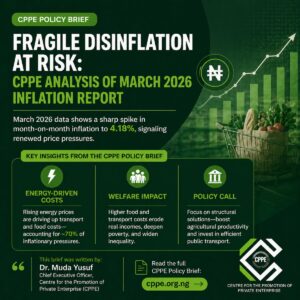
According to the CPPE, headline inflation rose marginally from 15.38 per cent in March to 15.69 per cent in April 2026, while food inflation climbed to 16.06 per cent and core inflation settled at 15.86 per cent.
The Chief Executive Officer of CPPE, Muda Yusuf, noted that although month-on-month inflation indicators showed signs of moderation, the cost burden on businesses and households remained severe.
He stated that food, transportation, energy products, healthcare and restaurant services accounted for about 87 per cent of inflationary pressure in April, stressing that the development continued to erode household income, especially among low-income earners.
Yusuf further observed that rural purchasing conditions appeared relatively more resilient compared to urban centres, reflecting the growing economic pressure associated with urban living conditions, transportation expenses and energy costs. He, however, noted that insecurity along rural transport corridors and rising logistics costs remain major contributors to high urban living expenses.
Similarly, the Lagos Chamber of Commerce and Industry warned that the rebound in inflation signalled renewed threats to business sustainability, poverty reduction efforts and economic competitiveness.
The Director General of LCCI, Chinyere Almona, stated that rising food inflation, transport costs and core inflation reflected deepening structural weaknesses in the economy.
According to the chamber, rising domestic fuel prices, worsened by geopolitical tensions in the global oil market, are intensifying cost-push inflation across production, logistics and distribution chains.
LCCI also expressed concern over the recent surge in global crude oil prices to about $112 per barrel and the upward review of Dangote Refinery’s gantry price to about ₦1,245 per litre, warning that pump prices could trend towards ₦1,500 per litre.
Although the current pump price of Premium Motor Spirit stands at about ₦1,320 per litre in many parts of the country, the chamber warned that prevailing market conditions indicate that further increases remain possible if global oil prices and supply-side pressures persist.
The chamber stated that the development could further worsen inflationary shocks across transportation, food supply and industrial production, thereby weakening consumer purchasing power and eroding business margins.
The business advocacy group attributed the persistent fuel affordability crisis to structural supply deficits in the downstream petroleum sector, noting that Nigeria’s daily petrol demand continues to exceed effective domestic refining capacity.
Both CPPE and LCCI maintained that Nigeria’s inflation challenge remains largely supply-driven, arguing that monetary tightening alone cannot adequately address inflation linked to energy costs, logistics inefficiencies, food supply disruptions and infrastructural deficits.
The groups warned that additional tightening measures could further increase borrowing costs for businesses, discourage investment and constrain productivity growth.
They therefore urged the Federal Government to prioritise structural reforms aimed at stabilising energy prices, improving transportation infrastructure, strengthening food supply systems, enhancing foreign exchange liquidity and supporting domestic production.
LCCI further called for urgent enforcement of domestic crude supply obligations to local refineries under the Petroleum Industry Act, alongside the implementation of a transparent naira-for-crude framework to reduce foreign exchange exposure and stabilise fuel prices.
The chamber also urged the government to accelerate the operationalisation of modular refineries, improve logistics systems and reduce distribution bottlenecks affecting the movement of goods across the country.
For businesses, CPPE advised firms to adopt energy-efficient operations, dynamic pricing strategies and affordability-driven product models, including smaller product packaging, as consumers become increasingly price-sensitive amid declining discretionary spending.
Economic analysts say unless structural reforms are aggressively pursued, rising inflation, weak purchasing power and high operating costs may continue to deepen poverty levels and weaken the survival capacity of many small businesses across the country.
In its assessment of the inflation outlook, the Centre for the Promotion of Private Enterprise maintained that Nigeria’s current inflationary trend reflects deeper structural distortions within the economy rather than excessive consumer demand. The group noted that rising energy costs, persistent logistics bottlenecks, poor infrastructure and disruptions in food supply chains continue to exert pressure on prices across major sectors, thereby limiting the effectiveness of conventional monetary policy measures.
CPPE further warned that additional monetary tightening by fiscal and monetary authorities could worsen the operating climate for businesses already struggling with high financing costs. According to the organisation, increased borrowing rates may discourage private sector investment, weaken industrial productivity and further constrain expansion plans for many small and medium enterprises already battling declining consumer demand.
On the energy front, the Lagos Chamber of Commerce and Industry described the recent rise in crude oil prices and fuel costs as a major stress test for Nigeria’s economic structure. The chamber noted that Nigeria’s dependence on imported petroleum products and inadequate refining capacity continue to expose the economy to external shocks, making domestic prices highly vulnerable to developments in the international oil market.
The chamber also stressed that energy costs remain a major component of production and distribution expenses for manufacturers and service providers. According to LCCI, rising fuel prices are rapidly transmitting inflationary shocks across transportation, agriculture, manufacturing and retail sectors, thereby eroding business profitability and weakening the purchasing power of households already facing rising living costs.
Both organisations also emphasised the need for stronger policy coordination and long-term structural reforms to stabilise the economy. While CPPE advocated targeted interventions to reduce the cost of food, transportation and energy, LCCI called for improved foreign exchange liquidity, enhanced domestic refining operations and accelerated investment in transport infrastructure. The groups maintained that sustainable economic recovery would depend largely on reforms capable of improving productivity, restoring investor confidence and reducing the cost of doing business across the country.