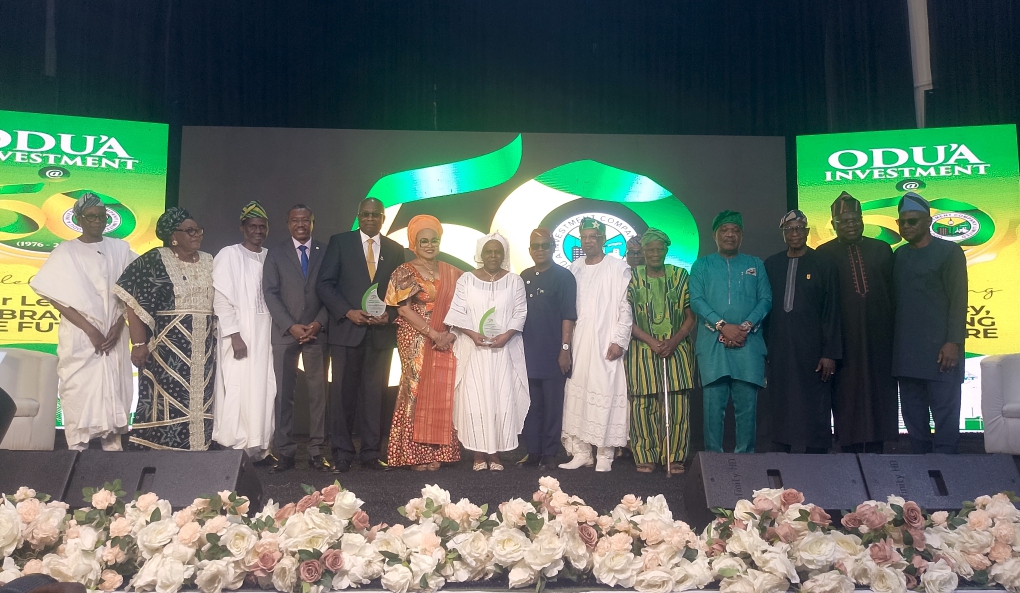
…As OICL targets N30bn profit, N50bn revenue by 2030, chairman, MD challenge Southwest states to preserve founding vision; keynote speaker urges institution to look beyond past glory
Fifty years after it was established to preserve and grow the economic assets of the former Western Region, Odu’a Investment Company Limited (OICL) is confronting a defining question: Can an institution built on the economic vision of Nigeria’s founding regional leaders transform its historic legacy into a globally competitive investment empire?
The question took centre stage on Tuesday, November 24, 2026, as the company marked its golden jubilee with an anniversary lecture at the International Conference Centre, University of Ibadan, Oyo State, where its leadership, shareholders, business partners, traditional rulers and other stakeholders gathered to reflect on five decades of institutional existence and examine its prospects for the next 50 years.
Beyond the ceremonial atmosphere associated with golden jubilee celebrations, the event presented an opportunity to examine the company’s difficult journey, its renewed financial performance and the ambitious restructuring programme designed to reposition it as a major investment institution in Nigeria and beyond.
With the theme, “Celebrating Our Legacy, Embracing the Future,” the anniversary brought together the Group Managing Director, Mr Abdul Rahman Yinusa; Group Chairman, Dr Tola Kasali; and the keynote speaker, Professor Bamitale Idowu Omole, former Vice-Chancellor of Obafemi Awolowo University, Ile-Ife, who challenged the institution to ensure that its next 50 years would be defined by innovation, competitiveness, accountability and measurable economic impact.
The central message from the three principal speakers was clear: Odu’a must not allow the achievements of its past to become a limitation to its future.
For an organisation that has survived political transitions, economic disruptions, leadership changes and years of operational difficulties, the golden jubilee represents more than an opportunity to celebrate longevity. It is also a moment to determine whether the institution can translate its historical significance into sustainable economic prosperity.
A VISION BORN OUT OF REGIONAL ECONOMIC SELF-RELIANCE
To understand the significance of Odu’a Investment Company, it is necessary to return to the economic philosophy that shaped the old Western Region in the 1950s.
Under the leadership of the late Chief Obafemi Awolowo, the Western Regional Government pursued an ambitious development programme founded on indigenous enterprise, regional cooperation, industrialisation and economic self-reliance.
The philosophy was that government should not merely administer public resources but also create institutions capable of generating wealth, providing employment and establishing sustainable economic foundations for future generations.
One of the most visible expressions of that vision was Cocoa House in Ibadan, an imposing 26-storey building conceived during the 1955–1960 development plan and commissioned in 1965 under the administration of the late Chief Samuel Ladoke Akintola.
At the time of its construction, Cocoa House was regarded as the first skyscraper in West Africa, symbolising the ambition of a region determined to translate its agricultural prosperity into lasting infrastructure and commercial development.
For Professor Omole, the building represented much more than an architectural achievement.
Recounting his childhood fascination with the imposing structure, the former OAU vice-chancellor described how news of the devastating fire that gutted Cocoa House in 1985 deeply affected him, even while he was studying in France.
He recalled that when the building was rehabilitated and reopened in August 1992, its restoration gave him a sense of relief, describing the experience as similar to recovering a precious possession that had once been lost.
According to him, Cocoa House remains a standing monument to the power of imagination, collective enterprise and the ability of a people to convert the wealth of their land into enduring economic assets.
However, the professor stressed that the building represents only one aspect of the broader economic vision that eventually gave rise to Odu’a Investment Company.
Following the creation of Oyo, Ogun and Ondo states in 1976, questions emerged over the ownership and management of the numerous business interests inherited from the former Western Region.
Rather than dismantling the existing portfolio and distributing the assets among the newly created states, the governments opted for a collective investment arrangement that would preserve the businesses and allow them to continue operating as a unified economic institution.
This decision led to the incorporation of Odu’a Investment Company Limited in July 1976, with operations commencing on October 1 of the same year.
The company initially took over more than 60 enterprises and business interests, including investments in hospitality, agriculture, manufacturing, real estate and other commercial sectors.
Professor Omole recalled that an implementation committee headed by the then military governor, General David Jemibewon, approved an initial financial allocation of N7 million for the company on March 27, 1976.
From that modest financial foundation, Odu’a has evolved into a multi-state-owned investment holding company with interests across several sectors of the economy.
Following the creation of Osun State in 1991 and Ekiti State in 1996, the ownership structure expanded, while Lagos State became the sixth shareholder state on March 28, 2018.
Today, the six shareholder states are Oyo, Ogun, Ondo, Osun, Ekiti and Lagos.
For the keynote speaker, the decision by the founding leaders to preserve the inherited business interests rather than fragment them remains one of the most important lessons in the company’s history.
It demonstrated that political boundaries and governments could change, but the responsibility to preserve productive assets, create wealth and sustain economic development should remain constant.
FROM YEARS OF STRUGGLES TO A FINANCIAL RESURGENCE
While Odu’a’s history is associated with economic ambition and institutional vision, its journey has not been without difficulties.
In his welcome address, Yinusa acknowledged that the company experienced periods when its operations contracted, its subsidiaries lost their competitive positions and its original ambitions appeared increasingly distant.
He admitted that there were years when the institution concentrated more on survival than on achieving the aspirations of its founding fathers.
This difficult chapter formed an important part of the discussions at the anniversary lecture, particularly as the company’s current leadership seeks to reposition it for long-term growth.
According to Yinusa, Odu’a has now turned a corner, with its recent financial performance providing evidence of a gradual institutional recovery.
He disclosed that the company recorded a profit before tax of N24 billion in 2025, representing growth of more than 400 per cent.
He also revealed that Odu’a had maintained uninterrupted dividend payments to its six shareholder states over the last 10 years, describing the commitment as an obligation to stakeholders who entrusted the institution with their resources.
The Group Managing Director further disclosed that the company’s credit rating was upgraded from A+ to AA- by Augusto & Co. in 2025, with a stable outlook.
He attributed the improvement to stronger financial discipline, professional treasury management and better institutional governance.
Beyond its domestic credit rating, the company has also secured an international credit rating, a development Yinusa described as part of its determination to subject its operations to globally recognised standards.
For an organisation with a developmental mandate and multiple government shareholders, such improvements are significant because they could strengthen investor confidence, improve access to capital and provide opportunities for strategic partnerships.
However, Yinusa cautioned against complacency, noting that the company still faces challenges, particularly in corporate visibility.
He observed that some of Odu’a’s subsidiaries and physical assets enjoy greater public recognition than the parent company itself.
While Cocoa House, Premier Hotel and other investments remain familiar names, many Nigerians are less familiar with the institution that owns and manages these assets.
Closing this visibility gap, he said, has become an important part of the company’s repositioning strategy.
THE N1 TRILLION AMBITION: ODU’A’S ROADMAP TO 2030
At the centre of the company’s renewed ambition is its Strategic Roadmap and Corporate Restructuring initiative, known as SRC 2.0.
The programme is designed around three major pillars: financial discipline, operational excellence and strategic growth.
Under the initiative, Odu’a is targeting N30 billion in profit before tax, N1 trillion in total assets and N50 billion in group revenue by 2030.
These targets represent a significant expansion of the company’s present financial position and reflect its determination to move beyond the limitations of its traditional investment portfolio.
Kasali, in his address, described SRC 2.0 as a defining chapter in the company’s history, stressing that its ambition is to establish Odu’a as a stronger, more competitive and financially sustainable investment institution.
He explained that achieving the targets would require disciplined capital allocation, sound investment appraisal, effective risk management, strong corporate governance and commercially viable business opportunities.
The company is already pursuing investments and partnerships across real estate, hospitality, agribusiness, technology, upstream oil and gas, insurance and other emerging sectors.
Yinusa further indicated that the company’s longer-term expansion could include renewable energy, digital infrastructure and railway development, particularly in areas considered critical to the economic future of southwestern Nigeria.
The ambition is not simply to increase the number of businesses under its portfolio but to build an investment institution capable of competing effectively while maintaining its developmental responsibilities to its shareholder states.
Kasali emphasised that Odu’a occupies a distinctive position in Nigeria’s corporate environment.
Unlike conventional government-owned enterprises or privately owned conglomerates, he described it as a professionally managed, multi-state-owned investment holding company with a developmental mandate for southwestern Nigeria.
This dual responsibility, he noted, requires the institution to balance commercial profitability with the economic aspirations of the communities and states that own it.
OMOLE’S WARNING: DO NOT BECOME PRISONERS OF PAST GLORY
While the company’s leadership presented its financial achievements and future investment targets, Professor Omole’s keynote address offered a broader reflection on institutional sustainability and the responsibilities associated with inherited economic assets.
He warned that organisations celebrating major anniversaries must resist the temptation to become imprisoned by their historical achievements.
According to him, longevity alone is not the ultimate measure of institutional success.
Rather, the real test is whether an organisation can remain relevant, respected and indispensable in an increasingly competitive and rapidly changing economic environment.
He argued that Odu’a’s golden jubilee should serve as a period of institutional introspection, allowing its leadership and stakeholders to examine the reasons behind its establishment, assess the relevance of its achievements and identify the opportunities and challenges ahead.
The professor observed that the global economic environment had changed significantly since the company was established in 1976.
Technological advancement, globalisation, demographic changes, climate change and artificial intelligence are redefining productivity, business operations and institutional administration.
He noted that expectations around transparency, accountability, efficiency and responsible leadership have also become central requirements for organisations seeking to survive and compete in the future.
Consequently, he argued that Odu’a must look beyond what it has accumulated over the last five decades and consider what it has made possible for the region and what it must achieve in the coming years.
He also urged the company to recognise that its historical importance must be matched by contemporary relevance.
For him, the survival of Odu’a through decades of economic instability, inflationary pressures, foreign exchange difficulties and changing business conditions is worth celebrating.
However, the institution must now concentrate on consolidating its achievements, expanding its operations and creating new economic opportunities.
Drawing comparisons with other regional development institutions that emerged from Nigeria’s former regional structures, Omole noted that Odu’a’s continued existence provides an opportunity to reflect on the importance of institutional continuity and the preservation of productive assets.
His message reinforced the position of the chairman and managing director that the next phase of the company’s existence must be driven by deliberate strategy rather than nostalgia.
THE GOVERNANCE QUESTION AND THE TEMASEK MODEL
Another important issue raised by Yinusa was how Odu’a could achieve the governance standards, financial discipline and strategic clarity associated with internationally recognised investment institutions while retaining its regional development mandate.
He specifically referenced Singapore’s Temasek Holdings as a global benchmark from which Odu’a hopes to draw useful lessons.
The comparison reflects the company’s aspiration to operate with the professionalism, accountability and commercial orientation expected of a globally competitive investment holding company.
However, the challenge is how to adapt such standards to the peculiar realities of a Nigerian institution jointly owned by six state governments.
The company’s management believes that stronger corporate governance, professional management, strategic investment decisions and consistent financial discipline are necessary to achieve this balance.
Kasali also called on the shareholder states to sustain their collective commitment by providing an enabling environment, policy support and the stability required for long-term investment decisions.
He maintained that the responsibility for building Odu’a’s future should not be left to the board and management alone.
Employees, business partners, investors, governments and communities must all contribute to the institution’s continued growth.
BEYOND PROFITS: THE SOCIAL RESPONSIBILITY DIMENSION
Despite the emphasis on financial performance and investment expansion, Odu’a’s leadership maintained that the company’s success must also be measured by its impact on the lives of people across the Southwest.
Kasali stressed that the institution’s developmental responsibility should remain an important part of its corporate identity.
Through the Odu’a Investment Foundation, the company is pursuing interventions in youth empowerment, education and healthcare.
As part of the anniversary activities, Yinusa announced plans to distribute educational books to at least 12 public schools across the region.
The books, covering Mathematics and English Language, were presented as a practical expression of the company’s belief that education remains fundamental to sustainable development.
The initiative also provided an opportunity to connect the anniversary celebration with the aspirations of younger generations, particularly students who attended the event.
The company equally recognised its employees, business partners and other stakeholders whose contributions have sustained its operations over the years.
Yinusa disclosed that long-serving employees would be honoured at the anniversary dinner, while the families of the company’s founding fathers would also receive recognition for the sacrifices and vision that gave birth to the institution.
Such gestures, the management explained, were intended to demonstrate that preserving the founding legacy requires more than ceremonial tributes; it requires institutional performance capable of justifying the confidence placed in the organisation by its founders.
WHAT SHOULD ODU’A LOOK LIKE IN 2076?
Perhaps the most significant question emerging from the anniversary lecture was not about the company’s present financial position or its 2030 targets, but what it should represent when it celebrates 100 years of existence in 2076.
Kasali challenged stakeholders to imagine an institution with a substantially stronger asset base, a diversified and globally competitive investment portfolio, world-class corporate governance and a respected corporate brand.
He said the ambition should be to build an organisation that future generations of southwestern Nigerians would be proud to inherit.
Yinusa offered a similar perspective, expressing the hope that future leaders of the company would look back at the present generation and describe them as disciplined, strategic and committed to delivering on their responsibilities.
For the managing director, the success of the current leadership would ultimately be determined by the strength of the institution it hands over to the next generation.
This long-term perspective is particularly important for an investment company whose founding philosophy was based on preserving wealth and creating sustainable economic opportunities beyond the lifespan of individual governments and administrations.
THE ROAD AHEAD
As Odu’a Investment Company enters its sixth decade, the challenge before its leadership is to convert its renewed financial performance and strategic ambitions into tangible results.
The N1 trillion asset target, N30 billion profit before tax and N50 billion group revenue by 2030 provide measurable indicators against which the company’s progress will be assessed.
But beyond the numbers lies a broader responsibility to demonstrate that a regional investment institution can operate professionally, compete commercially and still deliver meaningful developmental benefits to its shareholders and communities.
The company’s history has demonstrated the value of preserving collective economic assets. Its recent financial performance suggests that efforts are being made to rebuild its commercial strength.
However, the next phase will require sustained execution, investment discipline, transparent governance, strategic partnerships and the ability to adapt to emerging economic realities.
For the six shareholder states, the golden jubilee also presents an opportunity to renew their commitment to an institution that represents a shared economic heritage.
For the management and board, it is a reminder that the success of SRC 2.0 will be judged not by the ambition of its projections but by the actual results delivered.
And for the younger generation, the story of Odu’a offers an important lesson in the possibilities of collective economic vision, institutional continuity and the responsibility to preserve and improve what previous generations have built.
Fifty years ago, the founders sought to ensure that the economic assets of the old Western Region would not disappear with political restructuring.
Today, the challenge is considerably bigger: to transform those inherited assets into a diversified investment institution capable of creating wealth, supporting regional development and competing on a global scale.
As Professor Omole reminded the gathering, celebrating yesterday’s achievements must not make an institution insufficiently prepared for tomorrow’s challenges.
For Odu’a Investment Company, therefore, the golden jubilee is not the end of a remarkable journey. It is the beginning of another test of vision, leadership and institutional relevance.