In July last year, Ajayi Crowther University was 13,810th in the Webometrics world ranking of universities. In January this year it was 12,536th. In the July 2026 edition it was 6,215th out of more than 32,000 institutions.
That is a jump of more than 6,300 places in six months. Nationally, ACU moved from 114th to 61st among Nigerian universities, and from 520th to 317th in Africa.
Prof. Ebunoluwa Oduwole, who took over as the first female and fifth substantive Vice-Chancellor of the University on October 1, 2025, put the figures at the centre of her address on Monday at the press conference for the 18th convocation. By her own account, they are only the most visible part of a year she described as one of “unprecedented growth.”
The 10 points
Oduwole arrived with what she calls a 10-point agenda, built around academic excellence, student-centred welfare, staff development and better campuses. She said it is meant to reposition the university as “a beacon of academic excellence, Godly character, and innovation.” ACU is owned by the Church of Nigeria (Anglican Communion), and the words “Godly intellectuals” run through the address from the opening to the last line.
She gave the credit widely. She thanked the Governing Council under Dr. Olutoyin Okeowo, the Board of Trustees and the Supra Board West of the Anglican Church. “These achievements are not just statistics,” she said. “They represent lives transformed, futures secured.”
The class of 2026
The 18th convocation is where the year’s work meets the students. The university will confer degrees and diplomas on 4,104 people.
At the undergraduate level, 116 graduands will receive First Class honours, 1,207 Second Class Upper, 693 Second Class Lower and 45 Third Class. That makes 2,061 first degrees. Postgraduate awards come to 2,043: 158 postgraduate diplomas, 1,798 master’s degrees and 87 doctorates.
Oduwole said these graduates leave with more than a degree certificate. The university has been giving students extra certifications in Entrepreneurship, Artificial Intelligence and Mind Education, to make them more competitive in the job market. The Chairman of Council, she said, had directed that every student acquire basic knowledge of Artificial Intelligence. “Today, we are fulfilling that directive.”
On the student side, she listed improved hostels, stronger mentorship, regular fumigation of residences and quicker release of results and certificates.
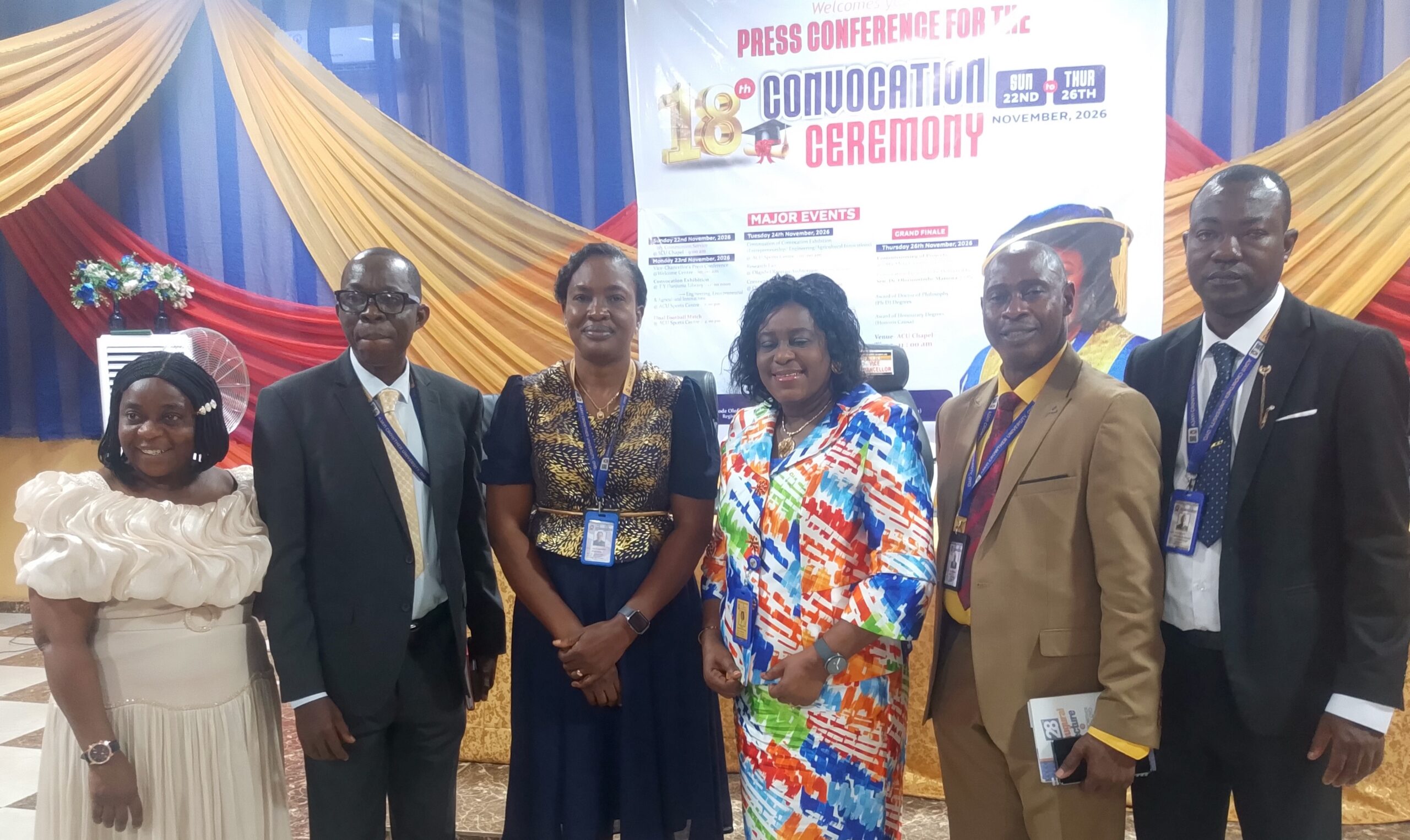
The programme runs through the week. A thanksgiving service came first, followed by a convocation exhibition, innovation shows in engineering, entrepreneurship and agriculture, a research fair, and the final of the Vice-Chancellor’s Cup football competition. A convocation play follows on Tuesday. Diplomas, bachelor’s and master’s degrees will be conferred on Wednesday, November 25, at the university chapel. Thursday is the grand finale, with the award of PhDs and honorary doctorates and the convocation lecture, “Youth Mental Health and Purpose: Thriving in a Volatile World.”
A bigger university
The academic changes are the bulk of the report.
The National Universities Commission (NUC) approved new undergraduate programmes in MBBS Medicine, Pharmacy, Anatomy, Physiology, Pharmacology, Public Health and Artificial Intelligence, all taking effect from the 2026/2027 session. It also cleared three media and communication programmes, in Broadcasting, Journalism and Media Studies, and Information and Media Studies. Postgraduate engineering programmes at master’s and PhD levels got a go-ahead as well.
Several existing postgraduate and undergraduate programmes won full accreditation, among them M.Sc. Accounting, Finance and Business Administration, and Radiography and Radiation Science. The university has created a separate Faculty of Computing, taken out of the Faculty of Natural Sciences.
The most striking single change is in law. The Council of Legal Education raised the Faculty of Law’s admission quota from 50 to 100 students for 2026/2027. The decision was taken at the council’s third-quarter hybrid meeting on August 13. ACU is one of only eight institutions to get an upward review.
The Director-General of the Nigerian Law School, Dr. Olugbemisola Odusote, had praised the performance of ACU’s law graduates at the school during an accreditation visit on April 29. Oduwole said she described their track record as a source of confidence in the quality of the faculty. The Dean of Law, Prof. Olanrewaju Onadeko, SAN, was singled out for thanks.
Oduwole also said she has asked postgraduate students to publish at least two papers a year in international journals. The university is working on a dedicated guest house and a fully furnished library for postgraduate and part-time students.
Grants, MoUs and the endowment
Money for research arrived from several directions. Deputy Vice-Chancellor (Academic), Prof. Afolake Olanbiwoninu, won a grant of more than 1.1 million Danish kroner from the Danida Fellowship Centre, in collaboration with the Technical University of Denmark’s National Food Institute. The five-year project, running from April 2026 to March 2031, will study locally sourced beneficial microbes to tackle nutrition and health problems among African mothers and children under five. Her inaugural lecture earlier in the year, on microbes and food safety, was one of five delivered during the period.
The university council approved ₦45 million for the second edition of the ACU Council Research Grant. On the partnership side, ACU signed a five-year MoU with the Cocoa Research Institute of Nigeria (CRIN) covering research on tree crops, exchanges, joint supervision of postgraduate students and agribusiness. It also signed an agreement with the Archbishop Vining College of Theology, Akure, to run postgraduate programmes in Christian Religious Studies, with degrees awarded by ACU. A third partnership, with the International Institute of Tropical Agriculture (IITA), Ibadan, covers biotechnology, laboratory equipment, ICT and cybersecurity. Twenty ACU students have already done industrial training there.
On June 18, the Archbishop of Ibadan Province, Most Rev’d Williams Aladekugbe, inaugurated the Ajayi Crowther University Development Endowment Foundation. It is meant to raise money for scholarships for deserving students regardless of their economic background, for modern classrooms and laboratories, and for research.
The people who run the place
Oduwole has put a good deal of the address into staff welfare, and she was specific. Salaries have been paid promptly and promotions given when due. According to her written address, staff also received a 40 per cent upward salary review.
She listed training programmes for almost every group on campus: a two-day workshop for drivers on road safety and ethical conduct, a technologists’ workshop on laboratory safety, a seminar for hostel supervisors and porters, a four-day retreat for newly appointed deans and heads of department, and the university’s first-ever workshop for shop owners operating on campus. She said she described the technologists as the university’s “engine room.”
The university also hosted the 2026 national training workshop of ANUPA, the association of university professional administrators. Six staff members completed a virtual course on improving university rankings, a subject that had suddenly become relevant. The health centre has been rehabilitated and now has a new ambulance. Parents and sponsors held a meeting with her on October 11, elected new leaders, and donated fans to the university.
Bricks and blocks
The construction list is the most concrete part of the report. Six projects are ready for commissioning this week.
At the Ajegunle campus, there are 16 self-contained staff quarters and a 64-bed female hostel, an extension of Beular Hostel. At Offa-Meta, the St. Michael Building, also known as the Ade Ojo Building, has been remodelled to NUC standards for the take-off of Medicine and Pharmacy, with lecture rooms for Nursing, and the College of Health Sciences building is finished. At Kiyeseni, at Olopoto-Awe, the administrative building for the Faculty of Agriculture is complete.
Work is still going on elsewhere. The Ajegunle chapel was blessed and committed to God on October 17, with formal dedication still to come. Two 382-bed hostels, one for women and one for men, are under construction at Offa-Meta, and staff quarters and lecture halls are going up at Kiyeseni.
The university has also taken on smaller jobs. It delivered 42 waste bins to the Environmental Management Unit, bought a slasher and a tipping trailer for the university tractor, and is rebuilding the sports pavilion and fields ahead of next year’s Nigeria Private University Games Association competition, which ACU will host.
At Osoogun, the university is developing a heritage and tourism site tied to Bishop Samuel Ajayi Crowther, the university’s namesake. Monuments connected with his capture and the history of slavery have been rehabilitated, and an agricultural project is being developed there with CRIN.
Town, gown and the chapel
Oduwole said she has worked to build ties outside the gates. She secured the support of the Alaafin of Oyo, Oba Abimbola Owoade I, and received a formal request from the Otan-Ayegbaju community in Osun State for a campus or faculty of ACU. She said relations with security agencies in Oyo town and the state are good.
The chapel remains central to the university’s identity, and she described a new agenda for staff and student fellowship. It includes a prayer convocation at the start of each session, a monthly faculty day, special programmes on the last Monday of each month, and the ringing of the belfry bell at St. Andrew’s Chapel as a call to worship. An attendance monitoring system is being introduced to encourage regular participation.
Two honourees
The ceremony on Thursday will also carry two honorary doctorates. Oduwole announced that the university will honour financier Mr. Kayode Falomo, founder of Greenwich Trust Limited, which became Greenwich Merchant Bank, and historian Prof. Toyin Falola of the University of Texas at Austin. She did not read their citations at the press conference and told journalists to come to the ceremony for them. Falola’s field, African history, sits close to the story of the man the university is named after.