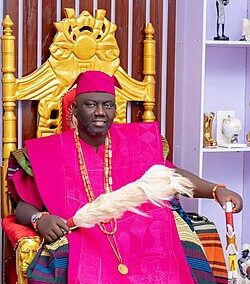
Kings are often remembered for the past they guard. The Alaafin of Oyo, Oba Abimbola Akeem Owoade, appears to be asking to be remembered for the future he builds from it.
That is the picture that emerged on Wednesday at the Palace of the Alaafin, where organisers of the maiden Oyo Empire Day briefed the press. Chairman of the Central Working Committee, Dr. Adekunle Ogunmola, repeatedly credited the celebration to the Oba’s vision: an annual platform where people of Oyo ancestry, wherever they live, can reconnect with their roots, celebrate a shared heritage and “collectively look towards the future.”
An idea with a forward gaze
Heritage events can easily become exercises in nostalgia. Dr. Ogunmola described this one as something meant to leave a mark long after the drums stop. “The real test of success will be what remains after December,” he said.
The list of aims he gave points forward: a network of Oyo-related communities, stronger historical research, preserved family histories, new openings for local businesses, young people drawn to their heritage, and permanent institutions such as a proposed Museum of Yoruba Culture and Civilization and an Oyo Empire Day Hall of Fame. The committee’s ambition is that in ten or twenty years the celebration becomes a major annual homecoming with national and international participation.
The programme itself reflects the same instinct. Beside the carnival procession, the replica of Oyo-Ile and the Ajagunla drama sit lectures, colloquia and youth events, ending in a performance by an international musician of Oyo ancestry. The organisers say they want young people to see heritage “not as something confined to old books, palaces, or traditional ceremonies” but as a source of creativity, enterprise and innovation.
The Alaafin’s choice of the word “empire” is also telling. The historical Oyo, the chairman said, was far larger than today’s ancient city or Oyo State, with communities and institutions stretching well beyond. By building the celebration around that wider story, the Oba has opened a door to descendants in Kwara, Ogun, Osun, Ondo, Ekiti, Lagos, Kogi, the Republic of Benin, Togo and the diaspora.
Heritage without hierarchy
The most striking part of Dr. Ogunmola’s address was not the programme. It was the list of things he said the celebration is not.
It is not a political rally. It is not an attempt to recreate the Oyo Empire as a political entity. And, in the passage organisers most want the public to hear, it is “not about claiming that Oyo people are superior to other Yoruba groups.” It is “not a competition with other Yoruba festivals,” and it is not about “claiming ownership of every Yoruba cultural tradition.”
In a region where questions of origin, seniority and prestige can sometimes stir old sensitivities, the clarity matters. The committee is saying out loud that remembering Oyo’s history does not diminish anybody else’s.
The chairman put the principle in two sentences. Every Yoruba community, he said, has a history worthy of respect, “just as we believe Oyo has a legitimate right to celebrate its own historical contribution.” Respect, in this framing, runs both ways. No town has to shrink for Oyo to remember.
Identity stays where it is
The same reasoning shapes how organisers speak to communities with Oyo roots. Dr. Ogunmola said the homecoming is not about bringing those communities under the ancient city of Oyo or taking away their separate identities.
He went through the names one by one. Ilaro remains Ilaro. Arigidi Akoko remains Arigidi Akoko. Modakeke remains Modakeke, Ede remains Ede, Saki remains Saki, and so on through Igboho, Jebba, Ibadan, Ogbomoso, Porto Novo and Oyo Atiba itself. “We are celebrating historical connections, not imposing identities,” he said.
The invitation to those communities is therefore deliberately modest. Their ancestors left Oyo’s historic centres centuries ago and built lives elsewhere. Wherever they went, the chairman said, “there remains a historical connection worth understanding, preserving, and celebrating.” The message is that a family can honour where it lives and where it came from at the same time.
Scholarship over sentiment
The humility extends to how history will be treated. Day Two is devoted to lectures and colloquia, and the chairman said organisers recognise that interpretations differ and will not impose one narrative. Oral tradition, written records, archaeology and academic research are all to be examined side by side, and where scholars disagree, he said, disagreement “should not frighten us.”
His closing words reinforced the point. The committee wants to celebrate Oyo without claiming superiority over anyone, remember its history without romanticising it, and respect tradition while encouraging scholarship.
A common platform
Those who attend can expect spectacle, but the underlying offer is of a shared space: scholars, traditional authorities, artists and the public meeting on one platform to discuss and pass on history. The celebration is also meant to be open to Christians, Muslims and practitioners of traditional religion, and to treat women, youth, professionals and the diaspora as stakeholders, not spectators.
For a first edition, the numbers are modest and the tone is measured. Organisers expect around 20,000 people a day, with the event to be held every year on the third Thursday, Friday and Saturday of December. For the inaugural year, that points to 17 to 19 December 2026.
What the Alaafin appears to be offering, then, is less a monument to Oyo’s greatness than an invitation to a wider Yoruba family: come and look at the past together, take pride in your own, and build something for those who come after. If the committee’s account is borne out, the legacy of Oba Owoade’s Oyo Empire Day will be measured less by the size of the crowd than by the number of families who found their way home without having to leave anything behind.