By: Goodluck E. Adubazi, Abuja.
The Nigerian Correctional Service (NCoS), FCT Command, has disclosed that a total of 4,614 non-custodial measures (NCMs) sentences were recorded in the Federal Capital Territory between January and December 2025.
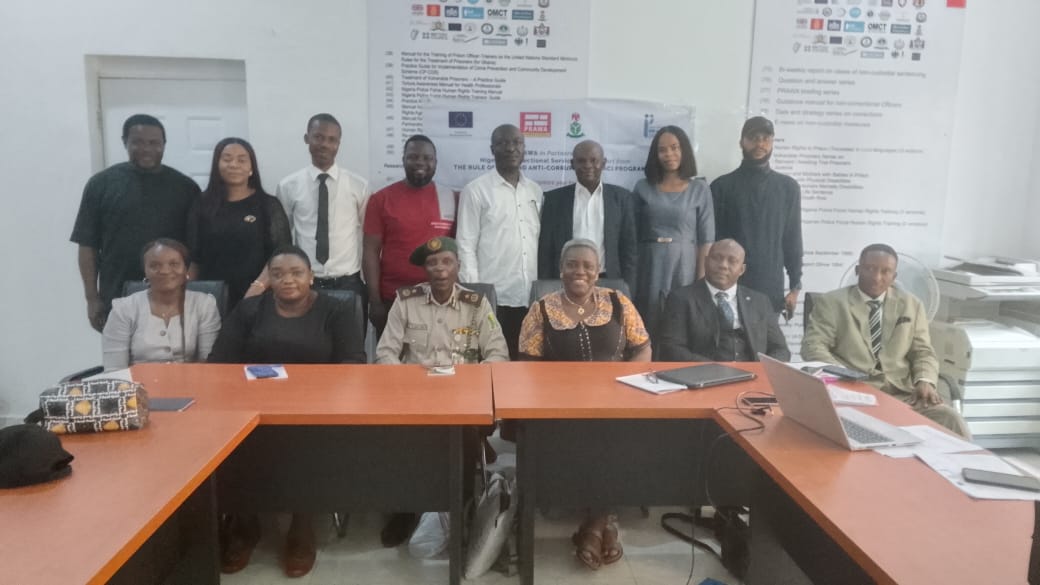
Deputy Controller of Corrections (DCC) Yusuf Yakubu, of the NCoS Non-Custodial Service, FCT Command, disclosed this on Tuesday in Abuja at a one-day workshop on Non-Custodial Measures for Civil Society Organisations (CSOs) and stakeholders in the FCT.
The workshop was organised by the Prisoners’ Rehabilitation and Welfare Action (PRAWA) in partnership with the Nigerian Correctional Service, with support from the Rule of Law and Anti-Corruption (RoLAC) Programme, under the Advancing the Implementation of Non-Custodial Solutions (AI-NCS) project.
Presenting a paper titled “Understanding Non-Custodial Measures (NCMs): Overview of Non-Custodial Measures Implementation in the FCT,” Yakubu said the enactment of the Nigerian Correctional Service Act, 2019, which repealed the Prisons Act, Cap P29, Laws of the Federation of Nigeria 2004, represented a paradigm shift from a purely punitive penal system to a more rehabilitative, restorative, humane and efficient framework.
According to him, the new framework is designed to conform with international best practices in the treatment of offenders.
Yakubu identified some of the benefits of non-custodial measures to offenders as incentives for good behaviour, preservation of family and social ties, reduction of stigmatisation and a lower risk of institutionalisation.
He added that society also benefits through the decongestion of correctional facilities, cost-effectiveness in the administration of justice, stronger community relations through restorative justice and reduced recidivism.
The Deputy Controller explained that the implementation of non-custodial measures in the FCT is anchored on Part 44 of the Administration of Criminal Justice Act (ACJA), 2015, which predates the Nigerian Correctional Service Act, 2019.
He said the law provides for alternative sentencing options, including community service, restorative justice, probation, suspended sentences and fines, among others.
Giving a breakdown of some of the NCM sentences recorded in 2025, Yakubu said 18 community service sentences and 10 other NCM sentences were recorded in January.
In February, he said, the Command recorded seven community service sentences and 60 other NCM sentences, while March recorded 34 community service sentences, one restorative justice sentence and 10 other NCM sentences.
He, however, said the combined total of NCM sentences recorded by the FCT Command from January to December 2025 stood at 4,614.
Also speaking, President of PRAWA, Dr. Uju Agomoh, drew the attention of participants to key provisions of the Nigerian Correctional Service Act, 2019, particularly Sections 12(4)–(12) and Section 44, describing them as important provisions for addressing overcrowding, prison decongestion and the sustainable implementation of non-custodial measures.
Agomoh, who spoke at the workshop in Abuja, said Section 12 of the Act establishes a legal mechanism for responding to overcrowding in custodial centres, while Section 44 provides a funding mechanism for non-custodial measures.
She explained that under Section 12(4), where a custodial centre exceeds its approved capacity, the State Controller of Correctional Service is required, within one week, to notify the Chief Judge of the State, the Attorney-General of the State, the Prerogative of Mercy Committee, the State Criminal Justice Committee and other relevant bodies.
For the Federal Capital Territory, she said Section 12(5) requires the Controller to notify the Attorney-General of the Federation and the Chief Judge of the FCT.
She further explained that under Section 12(6), the Controller-General is required to notify the Attorney-General of the Federation and the Chief Justice of Nigeria when correctional centres become overcrowded.
According to Agomoh, Section 12(7) requires the relevant authorities receiving such notifications to take necessary steps within three months to address the overcrowding.
She added that Sections 12(8)–(12) provide further mechanisms for controlling admissions, addressing congestion and ensuring that responsible justice-sector authorities take action when custodial centres reach or exceed their approved capacity.
Agomoh said the provisions effectively establish a legal early-warning and decongestion mechanism, ensuring that overcrowding in correctional centres does not continue unchecked.
She noted that the provisions are particularly important because one of the objectives of the 2019 Act is to establish sustainable mechanisms for dealing with the high number of awaiting-trial persons while promoting correction, rehabilitation and reintegration
Speaking on the role of CSOs in the criminal justice and correctional reform space, Agomoh urged emerging organisations to develop expertise, conduct research and identify areas where they could make meaningful contributions rather than simply duplicating existing interventions.
She recalled that her interest in criminal justice reform began early in her career when she conducted research involving the police and discovered that people processed through the criminal justice system often lacked adequate support, irrespective of whether they were eventually found guilty or innocent.
According to her, convicted persons frequently had underlying challenges such as limited education, inadequate livelihood skills, substance abuse and difficult family circumstances, while indigent persons accused of offences could also struggle to access justice because of poverty and lack of legal support.
She said these experiences reinforced the need for interventions that address the root causes of criminal justice challenges.
Agomoh encouraged CSOs to identify specific problems, understand their root causes, research possible solutions and develop specialised expertise in those areas.
She said training and capacity building remained one of the important strategies for strengthening the ability of organisations and justice-sector actors to respond effectively to identified challenges.
The PRAWA president also stressed the importance of linking research with advocacy, warning that organisations should not make policy recommendations on issues they have not adequately studied.
She urged CSOs to determine what research was required to support their advocacy and to use evidence to influence reforms.
Agomoh also highlighted the importance of media engagement, saying CSOs could use the media to educate the public, provide information, create awareness and draw government attention to issues requiring intervention.
She recalled PRAWA’s experience in using research, advocacy and media engagement to draw attention to correctional reforms and contribute to the legislative process that culminated in the enactment of the Nigerian Correctional Service Act.
She said the experience demonstrated that sustained advocacy, evidence and engagement with relevant stakeholders could contribute to policy and legislative change.
Agomoh further called for stronger internal and external independent oversight mechanisms within the criminal justice and correctional system.
She argued that violations of laws and rights could persist where there were no effective monitoring mechanisms or consequences for wrongdoing.
She therefore urged CSOs to identify areas where independent monitoring could strengthen checks and balances within the justice system.
She also highlighted the importance of care and support services, including direct assistance to inmates, ex-inmates, survivors and families through legal services, skills acquisition, healthcare and other forms of rehabilitation and reintegration support.
Agomoh stressed the importance of community participation and ownership in the work of civil society organisations.
She said CSOs should recognise that their work ultimately belongs to the communities they serve and that organisations hold their responsibilities in trust.
According to her, involving communities in interventions helps build legitimacy, sustainability and stronger support for reform initiatives.
She described non-custodial measures as essentially “community corrections”, explaining that they provide a way of holding offenders accountable without necessarily subjecting them to imprisonment and the associated social and economic consequences.
She said the approach was particularly important in addressing the challenges associated with overcrowding while supporting rehabilitation, reintegration and safer communities.
Earlier, in her presentation on the overview of the Advancing the Implementation of Non-Custodial Solutions (AI-NCS) project, Programme Officer of the Prisoners’ Rehabilitation and Welfare Action (PRAWA), Justina Laman, said the second phase of the project was designed to deepen and consolidate the achievements recorded during the first phase.
Laman explained that several activities were implemented during the first phase, including training for justice-sector stakeholders and the development and dissemination of resource and Information, Education and Communication (IEC) materials.
According to her, the first phase focused on the effective implementation of non-custodial measures, while the second phase, AI-NCS, seeks to advance, deepen and consolidate the gains already made.
She said the project is being implemented in eight locations across Nigeria, namely Plateau, Lagos, Anambra, Abia, Adamawa, Kano, Edo and the Federal Capital Territory (FCT).
Laman said the overall goal of the project was to deepen and consolidate the achievements of the first phase by enhancing the capacity of justice-sector service providers, CSOs and other relevant stakeholders to effectively implement non-custodial measures.
She identified four major objectives of the project as enhancing the capacity of justice-sector stakeholders to implement non-custodial measures; promoting the use of probation, parole, community service and suspended sentences; building the capacity of correctional-service training institutions; and supporting the rehabilitation and reintegration of offenders placed under non-custodial measures.
Speaking on the key activities under the project, Laman said training of parole board members was one of the major interventions.
She explained that while physical training sessions were conducted in the eight project locations, parole board members across the federation who were not physically present at those locations participated through online training.
She added that the project also provided training and retraining for correctional personnel on non-custodial measures, with physical sessions held in the eight project locations and other training conducted for correctional personnel across the country.
According to her, another component involved training Nigerian Correctional Service trainers on non-custodial measures to strengthen their capacity to cascade the knowledge within the Service.
She said specialised judicial training was also organised for judges and magistrates in the eight project locations, with emphasis on risk assessment and sentencing guidelines relating to probation, parole and suspended sentences.
Laman identified advocacy and awareness as another key component of the project.
She said advocacy was undertaken to promote the use of probation, parole and suspended sentences, while media campaigns were also carried out to increase public awareness.
She added that impact stories were collected and continue to be documented to assess the effect of the project.
According to her, IEC materials were also developed and are being disseminated to relevant stakeholders and the public.
On institutional training, Laman said the project was supporting correctional-service training institutions to build their capacity to integrate non-custodial measures into their training curricula.
She disclosed that monitoring and evaluation frameworks had also been developed and disseminated under the project.
She further explained that selected courts were being used as pilot sites for the practical implementation of non-custodial measures.
The project, she added, also supported the development of sentencing guidelines, with some participating locations already adopting or signing the guidelines, while efforts were ongoing to encourage similar adoption in other locations.
Laman also highlighted the provision of starter funds as part of the project’s educational, learning and reintegration support.
She explained that the funds were provided to selected persons serving non-custodial sentences to support their reintegration into society and enable them to become economically productive.
She said the project team would visit relevant NCoS commands to present the starter funds to beneficiaries in locations covered by the initiative.
According to Laman, the project is expected to result in increased judicial and stakeholder adoption of non-custodial measures, strengthened institutional capacity for offender rehabilitation, improved access to justice and greater adoption of non-custodial sentencing.
Other expected outcomes, she said, include empowering offenders for effective reintegration into society and contributing to a long-term reduction in prison overcrowding
On sustainability, Laman said one of the major strategies was to institutionalise non-custodial measures training within the curricula of correctional-service training institutions.
She explained that once the training becomes part of the institutions’ curricula, future personnel would continue to receive knowledge and training on non-custodial measures even after the project ends.
She added that the project also seeks to promote judicial consistency and equity, achieve a long-term reduction in prison overcrowding and improve the rehabilitation and reintegration of offenders.
Laman stressed that although the AI-NCS project has a defined lifespan, its ultimate objective is to establish systems and practices that will continue beyond the project period.
She said the initiative was ultimately aimed at reducing the number of people unnecessarily kept in custody while strengthening the use of effective, humane and sustainable alternatives to imprisonment.
The workshop brought together CSOs and other stakeholders in the FCT to deepen understanding of non-custodial measures, strengthen capacity and promote the effective implementation of alternatives to imprisonment.