Lauretta Fagbohun
Abeokuta.
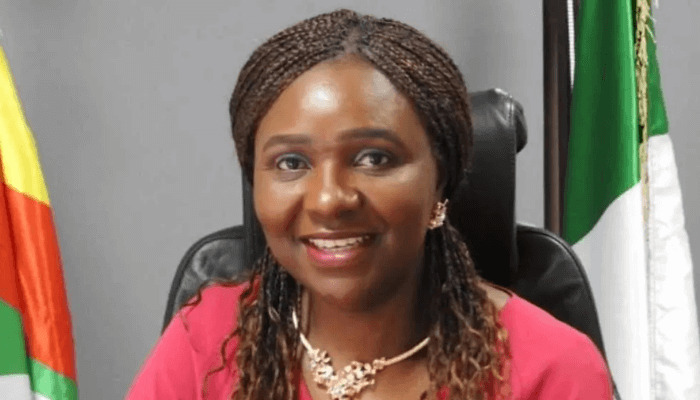
Former Accountant-General of the Federation, Dr Oluwatoyin Madein, has warned that Nigeria’s democracy could be vulnerable to manipulation if journalists fail to uphold truth, protect their professional integrity and restore public confidence in the media.
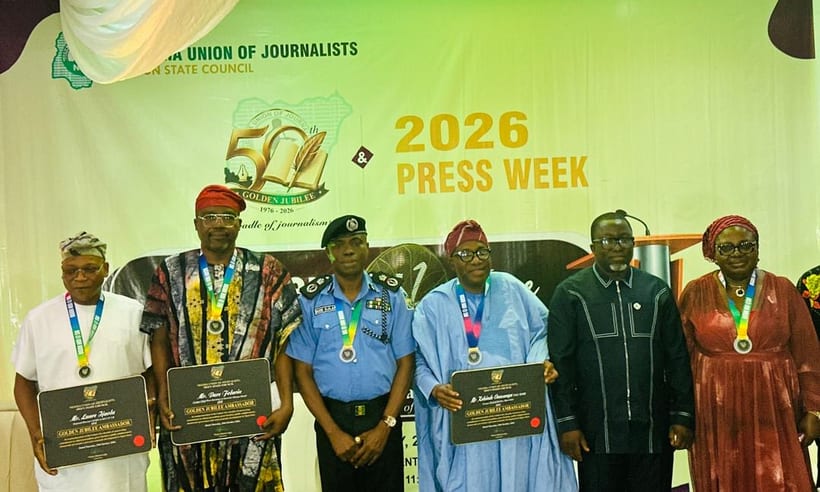
Madein gave the warning on Thursday while delivering the keynote address at the 50th anniversary celebration of the Nigeria Union of Journalists (NUJ), Ogun State Council, held at the Iwe Irohin Press Centre, Oke-Ilewo, Abeokuta.
The anniversary lecture, themed “Truth, Trust and the Press: Protecting Democratic Choice and Rebuilding Public Trust in Journalism,” examined the media’s responsibility in strengthening democratic institutions and ensuring credible electoral processes.
Describing the golden jubilee as a celebration of courage and a renewed commitment to truth, Madein highlighted Ogun State’s historic position as the birthplace of Nigerian journalism, following the establishment of Iwe Irohin by Reverend Henry Townsend in 1859.
She, however, noted that the journalism profession was facing one of its greatest challenges, as misinformation and falsehood increasingly spread faster than verified information, particularly in the digital age.
“Without truth, trust collapses; without trust, the press loses its moral authority; and without a credible press, democratic choice is left exposed to manipulation,” she said.
Madein acknowledged that artificial intelligence had provided journalists with valuable tools but cautioned that the technology could also be exploited to create convincing falsehoods. She added that social media platforms often prioritise sensationalism, speed and outrage over accuracy, stressing that journalists must remain committed to verification, patience and responsible reporting.
She maintained that the media’s responsibility was not to dictate electoral choices or usurp the roles of the Independent National Electoral Commission (INEC), the judiciary or the electorate, but to provide citizens with reliable information to make informed decisions.
According to her, journalists must defend the people’s right to know and ensure that public officeholders remain accountable. She also cautioned against practices capable of undermining electoral credibility, including vote-buying, fabricated endorsements, deepfake content and premature declarations of election winners before official announcements.
Governor Dapo Abiodun, in his remarks, represented by his Special Adviser on Media and Strategy, Kayode Akinmade, congratulated the NUJ Ogun State Council on five decades of contributions to democracy, governance and development.
The governor described the media as an important partner in his administration’s development efforts, urging journalists to maintain fairness, objectivity and professionalism in their coverage of public affairs.
“Remain fair and unbiased in your reportage. Where there are disagreements, let the facts speak. Where there are allegations, let verification precede publication,” Abiodun said.
Also speaking during a panel session, the Ogun State Commissioner of Police, CP Bode Ojajuni, identified weak institutional oversight as one of the challenges confronting journalism in the country.
Ojajuni called on relevant regulatory bodies to enforce professional standards and impose appropriate sanctions where established guidelines were breached. He also advocated continuous training and retraining for journalists, expressing concern that the growing influence of social media had blurred the distinction between professional journalism and unverified online publications.
Earlier, the Chairman of the NUJ Ogun State Council, Wale Olanrewaju, said the anniversary was not merely an occasion for celebration but an opportunity to address the fundamental challenges threatening the survival and credibility of journalism.
Olanrewaju recalled Ogun State’s rich journalistic heritage, from Townsend’s establishment of Iwe Irohin in 1859 to the contributions of prominent figures such as Obafemi Awolowo and Bisi Onabanjo. He, however, lamented that economic hardship, political interference and disinformation were weakening the media industry.
“Unpaid reporters and financially starved newsrooms cannot hold power accountable, reducing journalism to brown envelope sycophancy,” he said.
The NUJ chairman urged journalists to prioritise truth over access to influential individuals and defend their editorial independence despite the economic pressures confronting media organisations.