…Lamu refinery expected to boost Africa’s refining capacity, create 60,000 jobs and strengthen regional energy security
By: Goodluck E.Adubazi, Abuja.
The African Export-Import Bank (Afreximbank) has congratulated the Government and people of Kenya and the Dangote Group following the groundbreaking of a landmark oil refinery project in Lamu, describing the investment as a major step towards strengthening Africa’s industrial capacity and regional energy security.
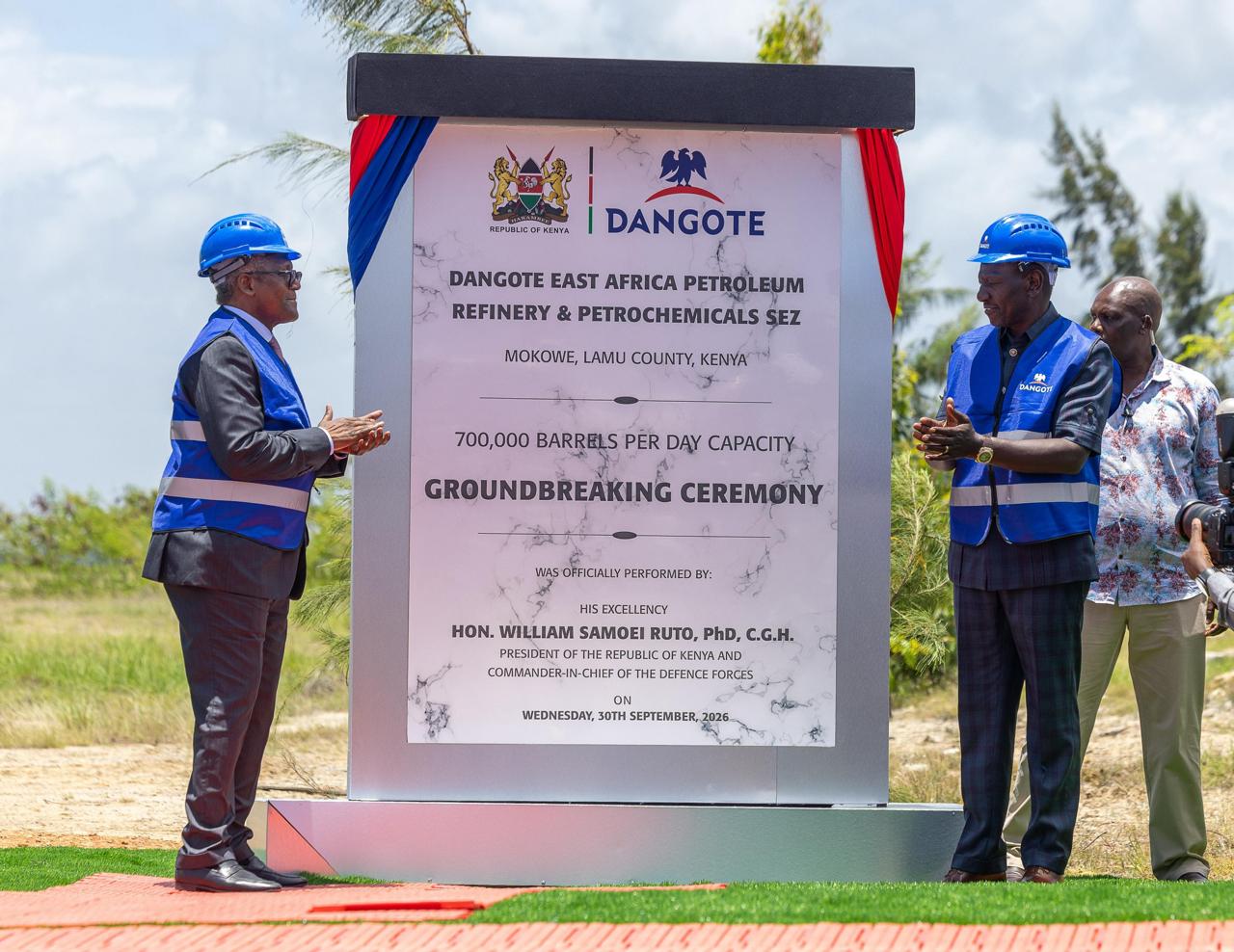
The groundbreaking ceremony for the Dangote East Africa Petroleum Refinery & Petrochemicals Special Economic Zone was held on September 30 in Mokowe, Lamu County, with President William Samoei Ruto and Dangote Group President and Chief Executive, Aliko Dangote, in attendance.
The approximately US$16 billion refinery is planned to process up to 700,000 barrels of crude oil per day and is expected to create about 60,000 jobs. The project is also designed to serve markets beyond Kenya, positioning it as a potential major industrial and energy asset for East Africa.
According to Afreximbank, the refinery is expected to process crude supplied by African producers, including Uganda, while providing refined petroleum products to Kenya and other regional markets.
Afreximbank President and Chairman of the Board of Directors, Dr George Elombi, said the significance of the investment goes beyond the construction of a refinery.
“The significance of this investment extends well beyond the construction of a refinery. It demonstrates Africa’s capacity to conceive, finance and build major industrial assets that respond directly to the needs of our economies,” Elombi said.
He said greater refining capacity on the continent would enable African countries to retain more value from their natural resources, create jobs and deepen trade links between African economies.
“By refining more of what we produce on the continent, we retain greater value from our natural resources, create jobs and strengthen the trade links between African economies,” he added.
Afreximbank said the Lamu project comes at a critical time for Africa’s energy security, with disruptions around the Strait of Hormuz and continued instability along the Red Sea and Bab el-Mandeb highlighting the vulnerability of supply chains for strategic commodities.
Elombi said recent disruptions to global energy and shipping routes had underscored the economic cost of excessive dependence on distant supply chains.
“Africa has the capital, the enterprises and the markets to reduce that exposure,” he said. “Investments such as this give us the productive capacity to shorten supply chains, conserve foreign exchange, strengthen regional energy security and build greater resilience into our economies.”
The bank said large-scale refining capacity could help Kenya and other African economies retain more economic value domestically, deepen industrial supply chains, generate employment and associated services, reduce dependence on imported refined petroleum products and create new opportunities for regional exports.
The Lamu refinery groundbreaking comes amid a broader expansion of Kenya’s industrial and trade infrastructure, with Afreximbank positioning itself as a long-term financial partner to the Kenyan government.
In 2023, the bank launched a US$3 billion Country Programme for Kenya to support priority public- and private-sector projects covering industrial development, export manufacturing, climate adaptation, irrigation, trade infrastructure and small and medium-sized enterprises.
The programme includes an US$800 million Kenya Climate Change Adaptation Facility, which supports irrigation development and agricultural productivity.
Afreximbank is also working with the Kenyan government and ARISE Integrated Industrial Platforms (Arise IIP) on the development of the Dongo Kundu Integrated Industrial Park in Mombasa and the Naivasha Special Economic Zone II.
Approximately US$1 billion has been earmarked for the two industrial parks, which are expected to attract investment, expand export manufacturing and strengthen Kenya’s role as an industrial and logistics gateway to East and Central Africa.
Government projections have linked the two developments to approximately 140,000 jobs when fully developed.
The bank has also expanded its support for the Vipingo Special Economic Zone in Kilifi County. In 2025, Afreximbank and KCB Group announced an US$800 million financing framework, comprising US$500 million from Afreximbank and US$300 million from KCB, to support businesses establishing operations in the zone.
Afreximbank had previously disbursed US$40 million towards development of the special economic zone, with the financing targeting manufacturing, agro-processing, logistics and other value-addition industries.
Afreximbank also commended Dangote Group for its continued investment in Africa’s industrial development.
The bank and Dangote Group have maintained a longstanding partnership focused on industrialisation, value addition and expanding productive capacity across the continent.
Since 2015, Afreximbank said it has invested approximately US$15 billion in the Dangote Group. Its support has included major financing for the Dangote Petroleum Refinery and Petrochemicals Complex in Nigeria.
In 2025, the bank signed a US$1.35 billion financing facility as part of an approximately US$4 billion syndicated financing package for Dangote Industries Limited.
In 2026, Afreximbank subsequently underwrote US$2.5 billion of a US$4 billion senior syndicated term loan for the refinery, representing the largest participation in the syndicate.
Since refining operations began, the bank has also provided a US$1 billion working-capital facility and served as financial adviser on the Naira-for-Crude initiative.
Elombi said Dangote’s expansion into East Africa demonstrated the growing role of African companies in driving continental industrialisation.
“African enterprises such as Dangote Industries demonstrate what is possible when African ambition is matched by investment at scale,” he said.
“They turn our natural resources into productive capacity — refineries, factories, supply chains, jobs and products that can be traded across African markets.”
He added that Africa’s transformation would increasingly depend on African companies investing across borders, African financial institutions supporting those investments and governments creating conditions for them to succeed
The Lamu project also aligns with Afreximbank’s broader strategy of developing an integrated African market for petroleum products refined on the continent.
In 2025, the bank established a US$3 billion Revolving Intra-African Oil Import Financing Programme, designed to facilitate an estimated US$10 billion to US$14 billion in intra-African petroleum imports and enable African buyers to source more refined products from refineries operating within Africa.
Afreximbank said globally competitive African enterprises and regional value chains would be critical to achieving the objectives of the African Continental Free Trade Area (AfCFTA).
The bank said investments such as the Lamu refinery, alongside Kenya’s expanding industrial parks and special economic zones, could help move African economies away from dependence on exporting unprocessed commodities and importing manufactured goods.
The broader objective, it said, is to build an African economy that increasingly produces, processes and trades for itself.