By: Lauretta Fagbohun, Abeokuta.
The Federal Government has dismissed concerns over the structural integrity of the Oju-Ore bridge in Ota, Ogun state, saying it has passed integrity tests and remains structurally stable.
The government also appealed to traders, pedestrians and other members of the public occupying or operating around the construction area to immediately vacate the site to enable the contractor to work safely and meet the project completion target.
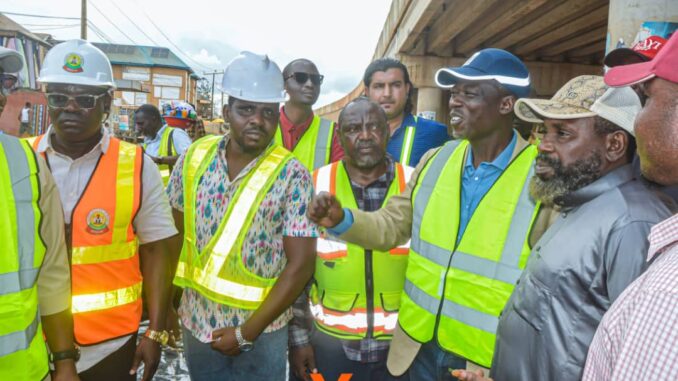
The position was made known during a high-level technical inspection of the bridge by officials of the Federal Ministry of Works, following concerns raised on social media over the safety and structural integrity of the ongoing project.
Speaking during the inspection, the Director, Bridges and Design, Federal Ministry of Works, Engr. Saidu Musa, who represented the Minister of Works, Engr. David Umahi, said the inspection was carried out in response to the reports circulating online.
Musa said the ministry had conducted the necessary integrity tests on the bridge, stressing that the results showed that the structure was stable.
“Based on the integrity test carried out on this bridge, it passed. The bridge is structurally stable. Don’t let anybody deceive you,” he said.
The director explained that the integrity of a major bridge could not be determined from photographs or videos posted on social media, insisting that proper engineering tests were required to establish the condition of such infrastructure.
He said the Federal Ministry of Works would not compromise standards, adding that the quality of work being executed by the contractor was in line with the approved specifications.
The Acting Federal Controller of Works in Ogun State, Engr. Adeleye Richard, who led the inspection team from the state, also affirmed the quality and stability of the bridge.
Adeleye said the project was being executed by indigenous contractor, Laralek, in accordance with the standards and specifications of the Federal Ministry of Works.
“My Director of Bridges here has confirmed that the works here are very, very stable and according to the specifications and standards of the Federal Ministry of Works,” he said.
He, however, identified the activities of traders and other members of the public within the construction corridor as a major challenge affecting the pace of work.
According to him, several makeshift markets and traders have occupied portions of the construction area, including spaces underneath the bridge, despite repeated warnings from the contractor.
He therefore appealed to community leaders to intervene and persuade the traders and other occupants to vacate the area.
“We want the community elders to talk to all these market women and men who are always disturbing within the construction vicinity to vacate the axis, to allow the contractor to work at an expected pace,” Adeleye said.
The contractor’s representative, Engr. Tope Ojo, also dismissed concerns about the quality of the bridge, saying the structure was being executed in accordance with the approved design.
Ojo said the span, bearings, beams and other major structural components had been constructed according to the approved specifications.
He added that integrity and quality-control tests had been carried out by independent consultants and that the results had been presented to the Federal Ministry of Works.
“All the integrity tests that are supposed to be carried out, quality tests, have been carried out. Everything regarding this bridge, all the tests that are supposed to be done were done,” Ojo said.
He explained that the major challenge facing the contractor was the continued presence of commuters, pedestrians and traders within the construction area, which he said had repeatedly disrupted construction ¹activities.
Ojo said barricades erected to secure sections of the work were often removed, forcing the contractor to rely qq1q¹¹ security personnel to clear the area before work could continue.
He appealed to the relevant authorities ⁰to assist in restricting public access to the construction zone.