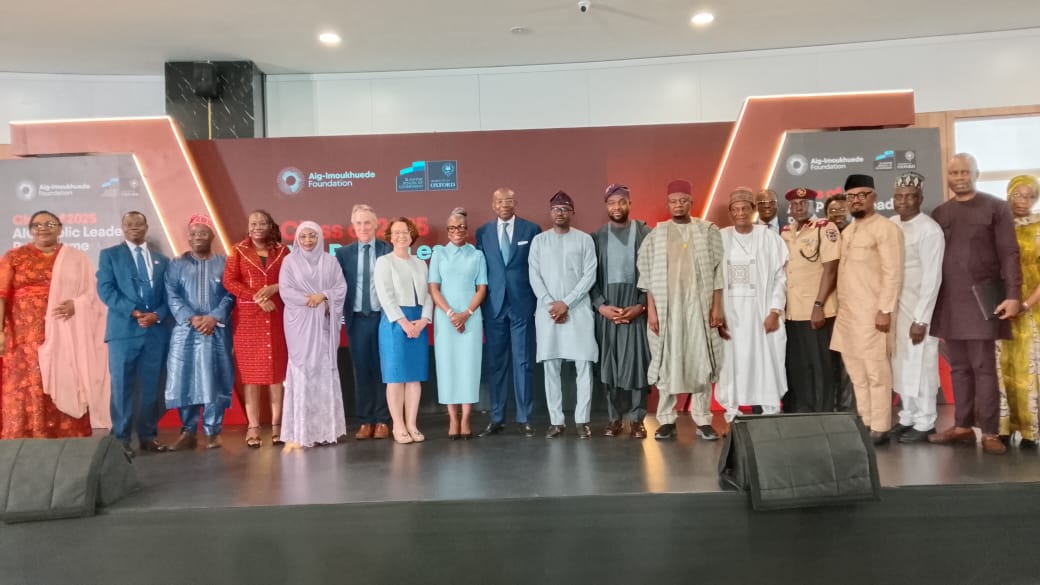
By: Goodluck E.Adubazi, Abuja.
The Minister of Interior, Olubunmi Tunji-Ojo, has declared that Africa’s most valuable resource is not its minerals or natural wealth but its people, stressing that true leadership is defined by what leaders create rather than what they inherit.
Speaking on Thursday in Abuja at the closing ceremony of the AIG Public Leaders Programme Class of 2025, organised by the Aig-Imoukhuede Foundation, the minister delivered a keynote address titled “Transforming Africa’s Public Sector: Lesson.s in Visionary Leadership, Accountability and Economic Renewal.”
Tunji-Ojo commended the foundation for its role in strengthening governance capacity across Nigeria and Africa, describing the initiative as a critical investment in public sector reform.
“The greatest asset of Africa is Africans,” the minister said. “If we truly understand the meaning of service, Africa will have a different story to tell.”
Tunji-Ojo emphasized that the public sector remains the most powerful institution shaping the everyday realities of citizens and organizing national opportunities.
According to him, being a public servant is one of the greatest honors, particularly in a country of over 240 million people like Nigeria.
He urged public officials to see their roles beyond personal ambition and instead focus on generational impact.
“A leader thinks of the next meeting, but a statesman thinks of the next generation,” he said.
The minister warned that Africa cannot overcome challenges such as insecurity, economic stagnation and underdevelopment without first addressing inefficiency within the public service.
In one of the most striking moments of his speech, Tunji-Ojo told participants that leadership must be judged by the systems leaders build and leave behind.
“Leadership is not about what you inherited. Leadership is about what you created,” he said.
He added that broken systems should not discourage leaders but instead provide opportunities to create lasting reforms and legacies.
Tunji -Ojo critical reforms in Nigeria’s interior ministry
highlighting practical examples from his tenure, the minister spoke about reforms implemented in agencies under the Ministry of Interior, particularly the Nigeria Immigration Service.
He revealed that the ministry inherited a backlog of more than 204,000 passport applications, some pending for as long as eight years. Through administrative reforms and improved efficiency, the backlog was cleared within two weeks.
Tunji-Ojo also highlighted the introduction of contactless passport application systems for Nigerians in the diaspora, allowing applicants to complete biometric verification and renew passports remotely using their phones.
The reforms, he said, have reduced bureaucratic bottlenecks and limited human contact that often enables corruption.
“If you want to reduce corruption, reduce human contact to the barest minimum,” he said.
He also cited the introduction of automated e-gates at Nigerian airports, designed to simplify immigration procedures and improve efficiency and
breaking away from “business as usual”
The minister urged public sector leaders to abandon outdated traditions that hinder innovation.
“If you want a legacy, you must be allergic to business as usual,” he said. “Your code must be business unusual.”
According to him, many public sector failures stem not from a lack of knowledge but from a lack of willpower to make difficult decisions.
Earlier, the Chairman of the Aig-Imoukhuede Foundation, Aigboje Aig-Imoukhuede, described the graduation ceremony as a milestone in the collective effort to build stronger public institutions across Africa.
He said the programme was created to equip high-potential public servants with the tools, networks and mindset needed to drive real reform.
“Africa’s future depends on the quality of leadership within its public institutions,” Aig-Imoukhuede said.
He warned that in an era of geopolitical tensions, economic realignments and technological disruption, African nations must move beyond rhetoric and deliver practical governance solutions that improve citizens’ lives.
Aig-Imoukhuede urged the graduating participants to go beyond certificates and demonstrate impact in their institutions.
“You are not here to manage the status quo. You are here to change it,” he told the cohort.
He emphasized that leadership requires difficult choices, including prioritizing long-term institutional strength over short-term popularity.
The event also featured several recognitions for outstanding contributions to public service and reform.
Among the awardees were:
Volunteer Awards: Timothy Soje and Ngozi Jessinta Akinbodewa
Innovation Award: Ebenezer Oladeinde
Young Leader Award: Akanimo Usoro Ernest of the Central Bank of Nigeria
Participants in the AIG Public Leaders Programme Cohort 5 represented a new generation of reform-minded public officials from Nigeria and other African countries.
Closing Remarks
In her closing remarks, the Executive Vice Chair of the Aig-Imoukhuede Foundation, Ofovwe Aig-Imoukhuede, thanked government officials, development partners and academic collaborators—including the Blavatnik School of Government—for supporting the programme.
She described the keynote address by the Interior Minister as a “masterclass in leadership,” adding that the knowledge shared would continue to inspire participants long after the ceremony.
As the fifth cohort of the AIG Public Leaders Programme graduates, the Honourable Minister say the real test now lies ahead—transforming training into tangible reforms that strengthen public institutions and improve lives across Nigeria and Africa.