By: Princess Don, Uyo.
Environmental reporting in the Niger Delta has entered a new phase as journalists undergo specialized training to strengthen investigative accuracy through structured data collection and analysis.
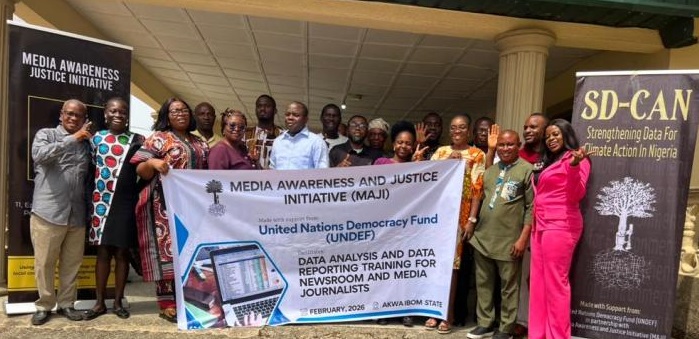
In a capacity-building workshop, titled “Harnessing Environmental Data for Reporting in the Niger Delta,” organized by the Media Awareness and Justice Initiative (MAJI) at the Nigeria Union of Journalists (NUJ) Press Centre in Uyo, targeted mainstream and citizen journalists seeking to deepen their understanding of environmental datasets and evidence-based storytelling.
Delivering the keynote session, MAJI’s Environment and Conservation Officer, Ikechukwu Ahaka, described environmental data as measurable records that quantify the state of air, water, soil, biodiversity and climate systems, as well as the pressures placed on them by human activity.
He explained that such data, sourced from satellites, electronic sensors, monitoring stations, field sampling and global databases provides objective benchmarks for assessing environmental health.
“Environmental data allows journalists to move beyond perception-based reporting. It strengthens credibility by grounding stories in measurable indicators,” Ahaka said.
Participants examined air quality indices, climate variability models, biodiversity statistics and land-use data, with emphasis on how these datasets can reveal pollution spikes, deforestation patterns and water contamination trends over time.
The workshop provided practical demonstrations on data cleaning, organization, visualization and interpretation. Trainers introduced participants to widely accessible tools including Microsoft Power BI, Google Looker Studio and Flourish for producing interactive dashboards and visual reports.
Open-source resources such as Google Earth Engine, OpenStreetMap and the World Bank Open Data portal were also highlighted as cost-effective tools for accessing satellite imagery, pollution metrics and development indicators.
Facilitators emphasized that newsroom adoption of these tools could improve investigative depth and reduce reliance on anecdotal claims.
A significant portion of the training focused on quality assurance standards. Journalists were advised to verify accuracy, ensure completeness of datasets, maintain consistency across sources, and confirm the timeliness and validity of environmental figures before publication.
Speakers warned that incomplete or poorly interpreted data could undermine public trust and weaken advocacy efforts.
The training also addressed challenges faced by investigative reporters, including limited access to government-held data, technical complexity of environmental metrics, and safety risks during field sampling in high-risk locations.
To mitigate these obstacles, MAJI recommended partnerships with research institutions, collaboration with community-based monitoring groups, and continuous professional development in investigative methods.
Dr. Prince Eze, who led the practical session on data analysis for advocacy, outlined a structured approach: cleaning datasets, categorizing information by location and pollutant type, visualizing patterns through charts and maps, and interpreting findings to inform policy debates.
He noted that data-backed reporting has historically influenced environmental reforms and strengthened accountability mechanisms, referencing initiatives such as the Hydrocarbon Pollution Remediation Project (HYPREP) in the Niger Delta.
“Raw numbers become powerful when translated into clear public messages that explain what they mean for environmental health and community safety,” Eze stated.
Participants were encouraged to apply the knowledge gained to local case studies within their communities, identify emerging environmental concerns, and monitor government commitments over time.
The workshop concluded with four central takeaways: environmental data enhances reporting credibility; impactful stories combine statistics with human experiences; collaboration strengthens investigative outcomes; and ethical reporting builds sustained public trust.
Organizers expressed optimism that the training would contribute to a stronger culture of evidence-based environmental journalism capable of promoting informed civic engagement and responsible environmental governance in the Niger Delta.