By, Goodluck E. Adubazi, Abuja.
The Nigeria Customs Service (NCS) has recorded its highest revenue haul in history, collecting a total of ₦7.281 trillion in 2025, surpassing its annual target of ₦6.584 trillion by ₦697 billion—a growth of over 10 percent above projection.
The figure also represents a strong year-on-year performance, rising from ₦6.1 trillion in 2024 to ₦7.28 trillion in 2025, an increase of approximately ₦1.18 trillion or 19 percent, underscoring what the Service describes as the tangible outcomes of sustained reforms.
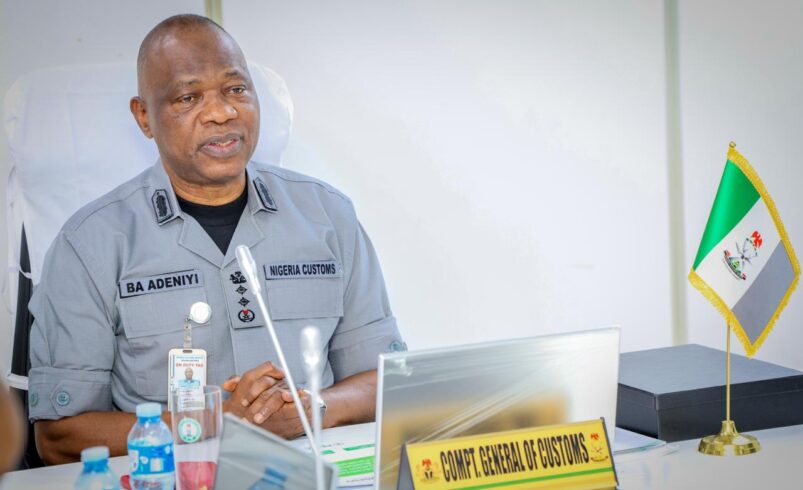
Speaking at the 2026 International Customs Day celebration and the official launch of the Nigeria Time Release Study (TRS), On Monday, at Ladi Kwali Hall, Abuja Continental Hotel, the Comptroller-General of Customs Adewale Adeniyi said the achievement was not a moment for self-congratulation, but proof that reforms anchored on compliance, technology, and collaboration are delivering results.
According to Customs Boss Adewale Adeniyi, the revenue gains were driven not by excessive enforcement or pressure on legitimate traders, but by better data utilisation, digital tools, improved compliance, and disciplined enforcement, all while strengthening partnerships with the private sector and maintaining trade facilitation commitments.
Looking ahead, the Customs boss outlined a three-pronged strategy to sustain the Service’s dual mandate of protecting society while enabling economic prosperity, especially amid complex global supply chains and technology-driven crime.
First, the Service will deepen intelligence-led and technology-driven enforcement, deploying tools such as risk management systems, non-intrusive inspections, post-clearance audits, and data analytics.
“The future of Customs enforcement is digital,” he said, noting that reliance on physical presence alone is no longer sufficient.
Second, Customs will institutionalize procedural reforms aimed at reducing cargo clearance times, increasing transparency, and eliminating avoidable bottlenecks. Central to this effort is the implementation of recommendations from the Time Release Study, including synchronized inspections, improved gate coordination, and stronger system interoperability across port stakeholders.
Third, the Service plans to strengthen partnerships with other government agencies, the organized private sector, port and maritime operators, financial institutions, and international bodies such as the World Customs Organization (WCO), stressing that both protection and facilitation are shared responsibilities.
Anchoring his remarks on the WCO’s 2026 theme, “Customs Protecting Society Through Vigilance and Commitment,” the Comptroller-General emphasized that Customs’ role goes far beyond revenue collection and tariff enforcement.
He highlighted major enforcement successes recorded in the past year, including the seizure of over 2,500 consignments valued at more than ₦59 billion, spanning narcotics, counterfeit pharmaceuticals, arms and ammunition, wildlife products, petroleum products, vehicles, and substandard consumer goods.
Among the notable operations were the interception of 16 containers of prohibited goods worth over ₦10 billion at Apapa Port, combining narcotics, expired medicines, and concealed firearms, as well as the rescue of over 1,600 exotic birds at Nigerian airports, disrupting a major wildlife trafficking network.
“These interventions may not dominate headlines for long,” he said, “but their impact is lasting—fewer drugs on our streets, fewer illegal weapons in circulation, safer medicines for patients, and protected ecosystems.”
Time Release Study: Data-Driven Reform
The launch of the Time Release Study, conducted at Tincan Island Port, marked a major milestone in Nigeria’s trade facilitation agenda.
The study provides the most comprehensive, data-driven assessment of cargo clearance processes in recent history, covering more than 600 declarations.
While the findings show that physical examination times are relatively efficient, they also reveal that idle periods caused by fragmented scheduling, manual documentation, and poor coordination significantly prolong clearance times.
“Our challenge is not that we cannot move goods fast,” the Customs chief noted. “It is that goods are not allowed to move fast.”
Armed with empirical evidence, the Service says it will transition from opinion-driven to evidence-based reforms, institutionalizing the TRS as a regular diagnostic tool to monitor performance and drive continuous improvement across the ports ecosystem.
The Comptroller-General acknowledged the support of President Bola Ahmed Tinubu, the Honourable Ministers, the World Customs Organization, the Government of the United Kingdom for supporting the TRS programme, and officers of the Nigeria Customs Service working under challenging conditions nationwide.
He also commended sister government agencies, private sector partners, and international collaborators, noting that Nigeria benefits most when institutions work together.
“As we celebrate Customs this year,” he concluded, “let us also recommit to making it more vigilant, more transparent, more efficient, and more committed to protecting society while facilitating lawful trade.”