By: Folaranmi, Adeoye.
In the crowded Uteh-Okha quarters on the edge of Benin City, life moves fast. Traders shout prices along the ever-busy roads, okadas weave through traffic, and children in school uniforms dash between houses. Yet for years, one building in the heart of this bustling community stood almost silent: the Uteh Primary Health Centre.
Serving over 16,000 people in an LGA of 372,000, the centre had become a symbol of quiet despair. Mothers stopped coming for antenatal care because there were no drugs. Children missed vaccines because the fridge was empty or there was no fuel for the generator. Deliveries happened at home or in private clinics far away. Health workers watched helplessly as preventable deaths occurred.
“We felt useless,” recalls Mrs Ewere, a community health extension worker who has served Uteh for three years. “Pregnant women would trek long distances only for us to send them away with nothing. It broke our spirit.”
The numbers from January 2024 to September 2024 were grim: an average of only 4 antenatal care (ANC) first visits per month, barely 1 skilled delivery, and just 25 children completing their full immunisation schedule in the best months. Essential medicines were perpetually out of stock, malaria tests were rare, and the centre closed by dusk because there was no light or security.
Then, in October 2024, everything changed.
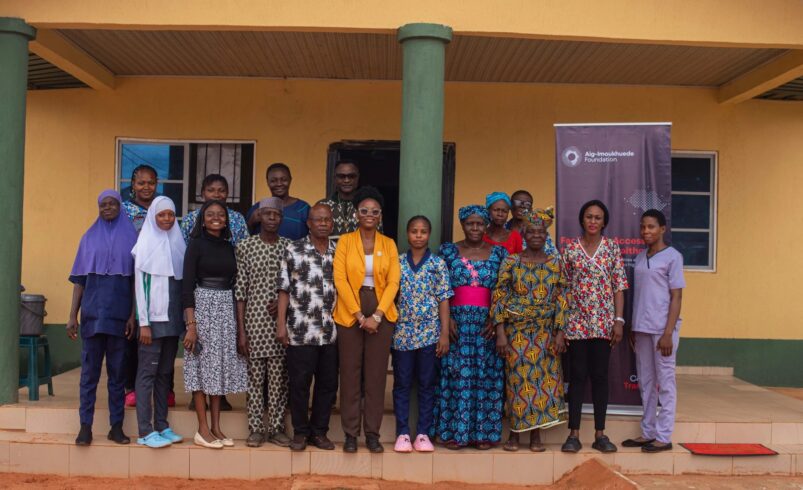
Through the Aig-Imoukhuede Foundation’s Adopt-a-Healthcare-Facility Programme (ADHFP), Uteh PHC became one of the first urban facilities selected for complete revitalization. The intervention was not a cosmetic touch-up; it was a root-and-branch reconstruction of a broken system.
New delivery beds arrived, vaccine refrigerators hummed on 24-hour power, shelves filled with antimalarials, antihypertensives, iron and folic acid tablets, and rapid diagnostic kits. Security guards were posted. Water flowed again. Most importantly, drugs and consumables began arriving every single month without fail.
The community noticed immediately.
Monthly patient visits increased from an average of 170 before the intervention to 398 between October 2024 and September 2025, representing a 134% rise. By June 2025, the centre recorded 635 visits in a single month. Antenatal first visits rose from 4 to an average of 7, peaking at 15 in July and August 2025. Skilled deliveries climbed from 1 per month to 5 in both July and August 2025.
Immunisation sessions, once sparsely attended, now draw long queues. The number of fully immunised children rose from an average of 25 to 39 in July 2025. Malaria testing exploded: 198 adults were tested in September 2025 alone, and every positive case was treated the same day. Pregnant women once again received intermittent preventive treatment (IPT) and insecticide-treated nets as routine.
Most remarkably, Uteh PHC recorded zero maternal deaths, zero infant deaths, and zero under-five deaths throughout 2024 and the first three quarters of 2025, an achievement almost unheard of in a nation where maternal mortality still stands at 993 per 100,000 live births.
For 24-year-old Blessing, pregnant with her second child, she speaks for many: “With my first pregnancy, I stopped attending ANC because the centre had nothing to offer. This time I come faithfully. They give me drugs, explain everything, and I now plan to deliver here. For the first time, I feel safe.”
Nurse Osarumwense, who has seen many false dawns, says the difference is simple: reliability. “Now we have light all night, security, and drugs every month. We can finally do our job properly. The community sees it and they trust us again.”
The transformation was not achieved by the Aig-Imoukhuede Foundation alone. Regular stakeholder meetings, revived Ward Development Committees, and consistent outreach programmes gave the community real ownership. Residents now monitor drug stocks, report gaps instantly, and hold the facility accountable, the true meaning of sustainability.
Chief Iyare, a respected community leader, sums it up: “This is no longer just a health centre. It is our health centre. When mothers and children are healthy, the whole community is strong.”
Uteh’s story is proof that Nigeria does not lack solutions; we lack consistent, holistic implementation. One fully supported primary health centre can save hundreds of lives and restore dignity to thousands.
Today, as evening falls over Uteh, the lights of the health centre burn bright. Mothers sit confidently in the waiting area. A newborn’s cry echoes from the delivery room. Health workers move with purpose instead of apology.
This is what primary healthcare should look like everywhere.
Call to Action
Nigeria can end its maternal and child mortality crisis one health centre at a time, but only if we act together.
Federal Governments: Prioritise full operational funding and drug supply for every PHC under the Basic Health Care Provision Fund.
State Government & Development Partners: Scale proven models like the Adopt-a-Health Facility Programme (ADHFP) to every ward in Nigeria.
Private Sector & Philanthropists: Join the Aig-Imoukhuede Foundation and adopt a health facility today. Your investment will save lives tomorrow.
Citizens & Community Leaders: Demand accountability, attend stakeholder meetings, and protect your health centre.
Uteh has shown the way. Let us follow and let no Nigerian mother or child be lost to a preventable death again.