…Continental leaders warn Africa risks ‘Digital exclusion crisis’ without urgent refo
By: Goodluck E. Adubazi, Abuja.
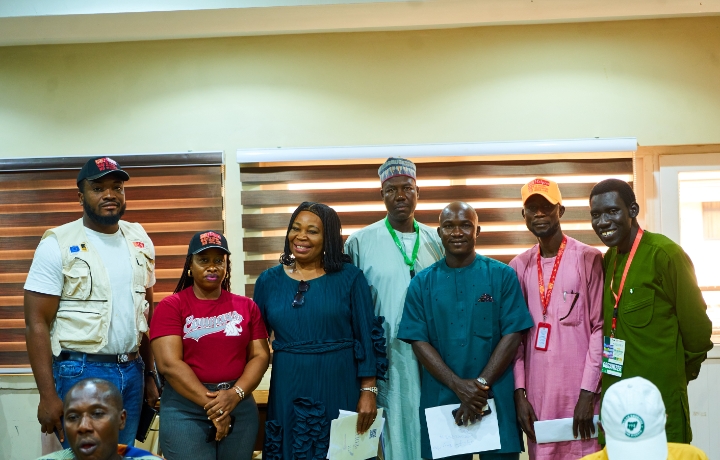
Africa’s education sector is standing at a historic turning point, experts declared on Thursday as policymakers, educators, civil society groups, and development partners converged at the Conference Hall, Federal Ministry of Education, in Abuja for the 4th Edition of the Future of Education in Africa Conference—an event that coincides with the end of the Continental Education Strategy for Africa (CESA) 2016–2025.
In a keynote address that drew repeated applause, speakers warned that the continent is entering a decade that will determine whether millions of African children are prepared for a rapidly evolving digital world—or left behind.
“We must confront the digital reality,” keynote speaker says
Delivering the headline address titled “Building a Sustainable Educational Future for a Resilient and Inclusive Africa: Evaluating CESA 2016–2025 Performance,” the keynote speaker, Oyegun Osamuyi
called on governments and institutions to act with urgency.
“We are not just talking about policies or statistics,” the keynote speaker said. “We are talking about our children, our teachers, our communities, and the future of a continent that holds some of the most gifted minds in the world.”
Launched in 2016, CESA represented a decade-long hope that Africa could transform its learning ecosystems, expand access, and prepare children for a competitive world. Across the continent, officials say, progress has been notable—rising school enrollment, increased teacher investment, and expanded technical and vocational training.
But the keynote speaker emphasized that Africa’s education sector remains deeply unequal, especially in digital access.
“During the pandemic, we saw children in cities attend live online classes while children in remote villages climbed trees just to catch a bit of network,” he said. “Teachers mastered Zoom in one region… while others lacked electricity to charge a phone.”
The digital divide, he warned, risks becoming “the defining inequality of the next generation.”
A new digital imperative
Speakers stressed that Africa’s future will be shaped by how effectively the continent equips learners for a digital age.
“African children are already living in a digital world,” he said. “But many lack the skills to stay safe from cyberbullying, misinformation, exploitation, and harmful online habits.”
He urged African governments to transition from viewing technology as an educational supplement to seeing it as a foundational skill—just as essential as mathematics or reading.
The vision he outlined includes:
Every school equipped with digital learning tools
Teachers empowered through world-class digital training
Universal access to safe, inclusive online learning
Cyber safety education for children and parents
Expanded support for African tech innovators
He described a future where “a girl in Katsina, Kisangani, or Cape Coast can learn coding the same way she learns mathematics,” and where children in refugee camps can study using rugged solar-powered tablets.
“This is possible,” he insisted. “It is within reach—and it begins with the decisions we make now.”
Organisers Say: ‘Africa is at a defining moment’
Earlier, Tama Monday Yari, Executive Director of the African Center for Youth Development, Education and Advocacy Initiative (ACYDEAI), opened the conference with a call for renewed unity and innovation.
“This year’s gathering is particularly significant,” Yari noted, “as it coincides with the conclusion of Africa’s most ambitious decade-long blueprint for transforming education—CESA 2016–2025.”
Yari emphasized that while the continent has made remarkable progress, the remaining challenges demand new courage, new partnerships, and new ideas.
“Our goal is simple yet profound,” he said. “To exchange practical solutions, strengthen partnerships, elevate homegrown innovations, and chart a forward-looking roadmap that carries every child, every community, and every nation along.”
He expressed gratitude to the Federal Ministry of Education, National Commission for UNESCO, National Commission of ICESCO, and other partners whose support is shaping a more inclusive and resilient education ecosystem.
A call for continental cooperation
As discussions continue, conferees agree on one thing: the next decade of African education will require cross-sector collaboration—governments, educators, private sector leaders, tech companies, and development partners working in unity.
“Education is not just a classroom issue,” the keynote speaker said. “It is a societal issue.”
The future, he added, must be one in which Africa’s children are not merely users of technology but creators and global competitors.
“If we choose courage, creativity, and collaboration,” he said, “the next generation of Africans will not only step into the world with confidence—they will reshape it.”