
When the Air Turns Against You: Living in the shadow of Aba-Odo’s landfill
- January 11, 2024
- 0
The first thing that hits you at Aba-Odo is not the sight of refuse or the distant hum of trucks; it is the smell. Thick, sour, and unforgiving,



9621 Agnes Crossing, Lake Suzanneview, New Mexico Island 84604-9295.
The first thing that hits you at Aba-Odo is not the sight of refuse or the distant hum of trucks; it is the smell. Thick, sour, and unforgiving,
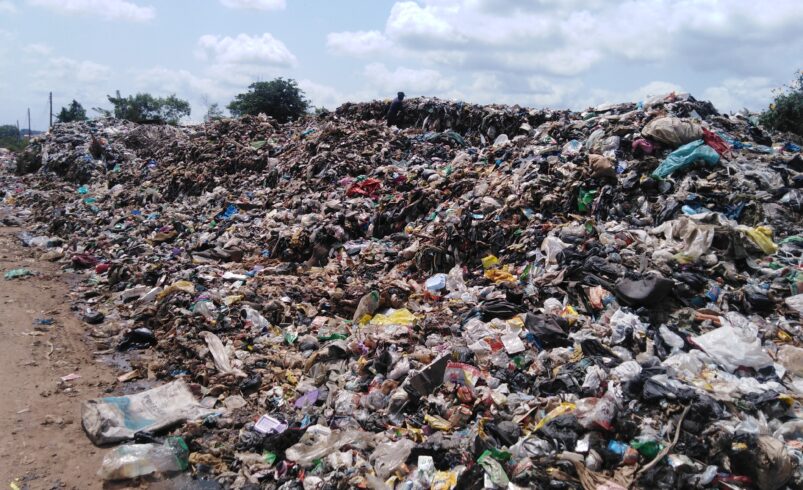
The first thing that hits you at Aba-Odo is not the sight of refuse or the distant hum of trucks; it is the smell. Thick, sour, and unforgiving, it crawls into your nostrils long before the landfill comes into view. Sitting in a commercial bus on the Oyo–Ibadan expressway, I watched passengers wrinkle their faces, pull shirts over their noses, and mutter curses under their breath. Some laughed nervously. Others fell silent. Within seconds, the source revealed itself: the sprawling Aba-Odo landfill, breathing heavily into the lives of those who live beside it.
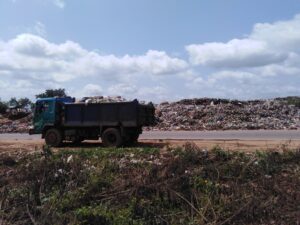
I alighted after a few minutes drive-away from the NNPC bus stop at Moniya and walked inward, away from the express road. Aba-Odo lies quietly between the bustle of Moniya and Akinyele Market and the constant movement of vehicles on the new expressway. On the surface, it is an ordinary peri-urban community, children playing barefoot, traders arranging goods, artisans welding under makeshift sheds. But beneath this normalcy is a daily struggle with an invisible enemy: hazardous pollutants rising steadily from the landfill that has become the town’s unwanted neighbour.
For commuters, the landfill is a momentary discomfort, a bad smell that fades once the bus speeds past. For residents, it is a permanent condition. The odour lingers in bedrooms, kitchens, classrooms, and shops. It wakes people up at night and greets them in the morning. “You don’t get used to it,” one resident told me quietly. “You only endure it.”
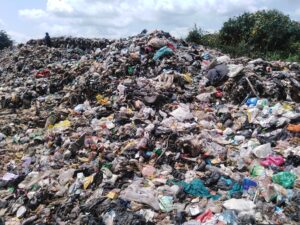
The Aba-Odo landfill is not new. It was relocated here in the early 1990s from Agodi Gate, after urban development swallowed up its former location. At the time, Aba-Odo was less populated, largely rural, and politically invisible. Decades later, the town has grown, but the landfill has remained, expanding alongside homes, schools, and markets, as if daring the community to complain.
And complain they have.
For over eight years, residents of Aba-Odo, alongside neighbouring Irepodun and parts of Akinyele Local Government, have written letters, staged appeals, and sought audiences with government officials through the Ministry of Environment. They have approached past representatives and, more recently, the newly elected lawmaker, Hon. Moshood Lakan Abiola. Yet, according to them, the landfill still stands, swallowing daily loads of refuse collected from across Ibadan.
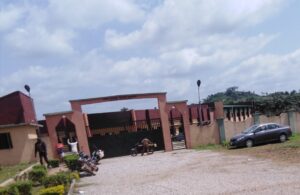
Ironically, in September 2023, the Oyo State Government publicly warned residents against indiscriminate waste dumping. The Commissioner for Environment and Natural Resources, Mr. Abdulmojeed Mogbonjubola, reaffirmed the state’s commitment to environmental cleanliness and promised sanctions for offenders. But in Aba-Odo, residents question the fairness of environmental discipline that cleans the city centre while concentrating its waste at their doorstep.
“This place has become a sacrifice zone,” Prince Alimi Abidemi, son of the immediate past Baale of Aba-Odo, told me as we stood a few metres from the landfill’s edge. He spoke calmly, but his eyes betrayed years of frustration. According to him, the landfill has altered life in Aba-Odo—disrupting farming, worsening health conditions, and lowering the community’s overall quality of life. “People fall sick often. Children cough regularly. Yet we are told nothing can be done.”
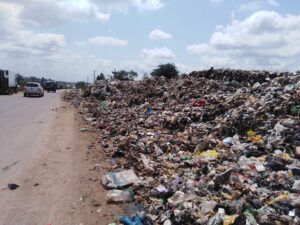
At the palace of Irepodun township, Chief Yekini Ojo, the Baale, acknowledged the gravity of the situation. He assured residents that he would formally write to the appropriate authorities and expressed confidence that Governor Seyi Makinde would intervene. Still, for many residents, assurances have become painfully familiar.
In 2022, desperation briefly turned into resistance. Mr. Aponmode Hammed, an artisan, recalled how youths in the community mobilised to block trucks from dumping refuse at the site. “We were tired,” he said. “The smell was unbearable. People were sick. But we were told to stand down.” His plea is simple: relocate the landfill far away from residential communities.
The economic toll is just as visible as the environmental one. Along Aba-Odo Express, Mrs. Maryam Oladimeji’s fans fly away from her food stall with one hand while serving customers with the other. Or at least, she tries to. “Some days, nobody buys,” she lamented. “Once they smell it, they just walk away. How do we survive like this?”
Medical experts warn that such environments are far from harmless. Research shows that people living near landfill sites are more prone to asthma, skin irritation, gastrointestinal disorders, and recurring flu-like symptoms. Continuous exposure to toxic fumes, dust, and chemical emissions slowly erodes health, often without immediate warning.
A 2019 study on landfill operations revealed their significant contribution to greenhouse gases such as methane and carbon dioxide, as well as the contamination of surface and groundwater through leachate. Methane exposure, experts say, can cause nausea, loss of coordination, and in extreme cases, death.
Dr. Mrs. Abdulrasheed Khadija Afolashade, a medical practitioner, explained that acidic gases like nitrogen dioxide and sulfur dioxide irritate the nose and throat, worsen respiratory infections, and trigger severe symptoms in asthmatic patients. “Long-term exposure,” she said, “is a silent threat.”
As I left Aba-Odo that evening, the sun dipped behind the landfill, casting a dull haze over the community. Children still played. Traders still sold. Life went on, resilient, but strained. The landfill remained unmoved and unbothered.
For Aba-Odo residents, this is not just an environmental issue; it is a human one. It is about dignity, health, and the right to breathe clean air. Until the landfill is relocated or properly managed, the people here will continue to live with a burden they did not create, waiting for relief that has been promised, delayed, and dangerously ignored.