By: Goodluck E. Adubazi, Abuja.
The Association of Senior Civil Servants of Nigeria (ASCSN) has aligned with the Nigeria Labour Congress (NLC) and the Trade Union Congress (TUC) in demanding an immediate and permanent upward review of salaries for federal civil servants, insisting that the Federal Government raise the salary of its lowest-paid worker to ₦300,000, with corresponding adjustments across higher salary grade levels.
The association rejected temporary palliative measures, describing them as inadequate responses to the worsening economic realities confronting Nigerian workers, and urged the Federal Government to take immediate action to improve workers’ welfare.
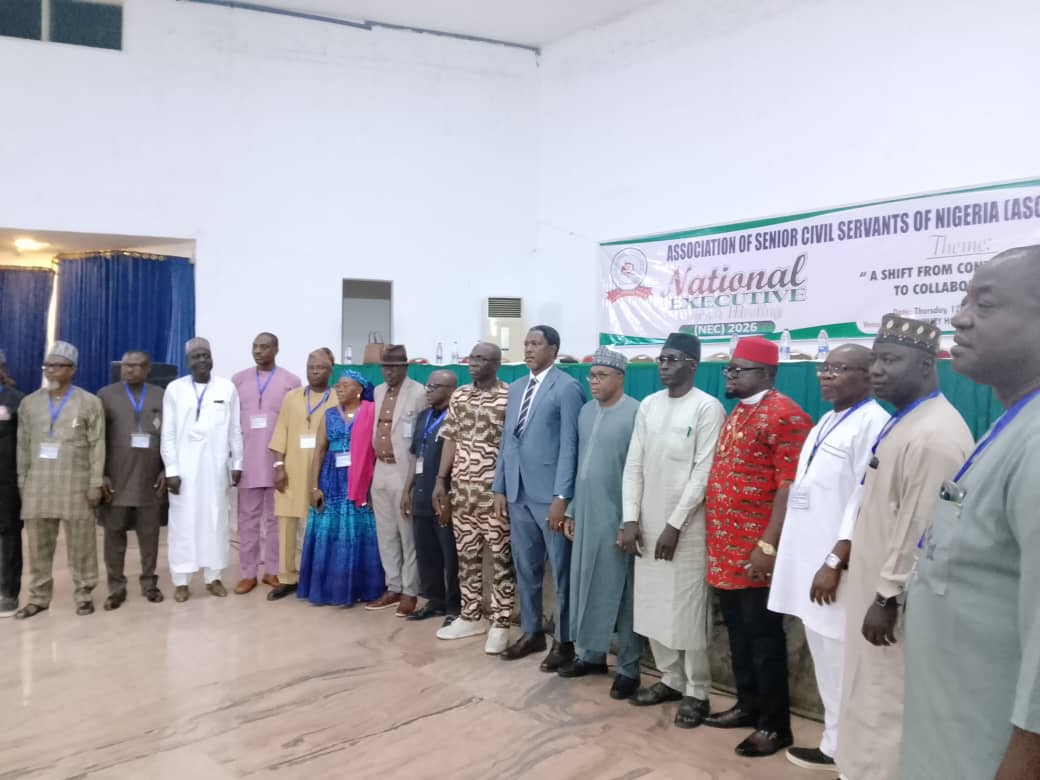
National President of ASCSN, Comrade Shehu Mohammed, made the position known on Thursday, November 12, 2026, in Abuja, while addressing the association’s National Executive Council (NEC) meeting themed, “A Shift from Confrontation to Collaboration.”
Mohammed stressed that collaboration between government and organised labour must translate into concrete improvements in workers’ welfare, career progression and protection of trade union rights.
He particularly condemned the prolonged stagnation of education officers in the federal civil service, attributing the situation to outdated establishment structures that restrict promotion opportunities.
According to him, it is unacceptable that education officers remain on the same grade level for nearly a decade while their counterparts in other sectors enjoy smoother career progression.
He called on the Office of the Head of the Civil Service of the Federation and the Federal Civil Service Commission to urgently create vacancies in the Director cadre for education officers within the Federal Ministry of Education.
The ASCSN president also demanded that inspectorate and educational administrative responsibilities be recognised in career progression arrangements, insisting that officers should not be disadvantaged for choosing careers in the education sector.
On labour relations, Mohammed condemned what he described as increasing management interference in trade union activities across federal ministries, departments and agencies.
He maintained that such practices violated Section 40 of the 1999 Constitution, which guarantees freedom of association, as well as applicable international labour standards protecting workers’ rights to independent union administration.
Citing the National Insurance Commission (NAICOM) as an example, he alleged that management resorted to hostility after the association raised concerns over unfair labour practices, including alleged lopsided promotions, vindictive transfers and neglect of staff welfare.
He further alleged that management attempted to undermine the legitimate union leadership by appointing a purported caretaker committee to administer union affairs.
Mohammed said the Federal Ministry of Labour and Employment had intervened and advised against such interference, but alleged that management disregarded the ministry’s directives and breached agreements reached with organised labour.
The ASCSN president warned that the association would not hesitate to deploy lawful industrial mechanisms, including nationwide picketing and withdrawal of services, against any federal institution attempting to destabilise trade union activities.
Despite these concerns, he reaffirmed the association’s commitment to collective bargaining and social dialogue, stressing that meaningful collaboration must be supported by transparency, mutual respect and prompt government action.
He urged NEC members and other labour leaders to approach the meeting’s deliberations with unity, clarity and determination to advance the interests of Nigerian workers.
Meanwhile, the Minister of Labour and Employment, Alhaji Muhammed Maigari Dingyadi, applauded ASCSN for adopting the theme, describing its emphasis on collaboration as a development capable of restoring confidence in government-labour relations.
The minister, who was represented by Amos, said the theme offered Nigerians hope by demonstrating that government and organised labour could resolve disagreements through negotiation rather than confrontation.
According to him, the NEC meeting was more than an ordinary gathering, but a statement of the association’s commitment to dialogue, partnership and national progress.
He explained that collaboration should not be mistaken for weakness or surrender, but should reflect maturity, mutual understanding and a shared commitment to finding solutions that benefit workers and the country.
Dingyadi reaffirmed the Federal Ministry of Labour and Employment’s readiness to work with ASCSN on issues concerning workers’ welfare, timely review of the national minimum wage through tripartite consultation, pension administration, training, decent work and the modernisation of the civil service.
He emphasised that President Bola Ahmed Tinubu believes that no government can succeed without a motivated workforce, noting that workers remain the nation’s greatest asset rather than a cost to be managed.
The minister urged participants to ensure that resolutions from the meeting were firm but fair, bold but peaceful, and ambitious but achievable.
He expressed optimism that the November 2026 NEC meeting would be remembered as a turning point in government-labour relations, where collaboration, partnership and nation-building took precedence over confrontation and protest.
He wished the association fruitful deliberations and commended its members for their service to the country.
The meeting brought together labour leaders and other stakeholders to deliberate on workers’ welfare, industrial relations, career progression and the future of the federal civil service.