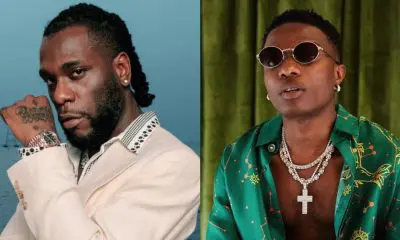
What began as a nightclub altercation has rapidly spiralled into one of the most explosive celebrity feuds in recent Nigerian entertainment history, with Burna Boy openly challenging Wizkid to a physical fight in a saga that has blurred the lines between music rivalry, ego, and street credibility.
The controversy erupted after an incident involving disc jockey DJ Tunez at a Lagos nightclub, where Burna Boy was accused of physically assaulting the DJ for allegedly refusing to play his songs.
The situation escalated further when Wizkid, widely seen as DJ Tunez’s close associate, publicly criticised Burna Boy and his entourage, accusing them of ganging up on the DJ during the confrontation.
Rather than de-escalate tensions, Burna Boy responded with defiance, initially claiming sole responsibility for the altercation and dismissing accusations that he relied on a group attack.
In a now-viral video, Burna Boy took things a step further, mocking Wizkid’s reaction and daring him to take the confrontation offline, framing the dispute as a clash between “real-life power” and “internet power.”
“Wizkid come go dey tweet. Na internet their own power dey. We na real life our own power dey,” he said in Pidgin, directly questioning Wizkid’s influence beyond social media.
His comments signalled a deeper rivalry, not just between two artists, but between contrasting personas: one projecting street dominance and the other digital influence.
Meanwhile, DJ Tunez offered a dramatically different account of the incident, alleging that Burna Boy attacked him from behind, describing the move as cowardly and unprovoked.
“This n*gga Burna Boy, all signs of weakness. First off, you hit me in the back of my head without me looking,” he wrote, escalating the narrative from a simple scuffle to a question of honour.
He further claimed he was outnumbered, insisting he stood his ground in what he described as a “1 vs 10” situation, portraying himself as a victim of coordinated aggression.
However, Burna Boy countered that version during a livestream with Shallipopi, swearing that no group attack took place and insisting he alone delivered “two slaps.”
“Na only me two slap na im I give am,” Burna said, even invoking a traditional oath to emphasise his claim and challenge the credibility of opposing narratives.
His statement reframed the incident as a personal dispute exaggerated by critics, while also subtly reinforcing his image as someone who handles conflicts directly.
As the controversy gained traction, misinformation began to spread, particularly claims that DJs across Nigeria had blacklisted Burna Boy’s music in solidarity with DJ Tunez.
This prompted a swift rebuttal from the Deejays Association of Nigeria, which categorically denied imposing any ban and described the reports as false and misleading.
DJAN President Prince Akim Edeh clarified that DJ Tunez is not even a registered member of the association, distancing the body from the conflict entirely.
The association also condemned the unauthorised use of its logo in spreading the alleged ban, signalling how quickly the incident had been politicised within industry circles.
Despite distancing itself from punitive action, DJAN emphasised its opposition to violence and confirmed it was monitoring ongoing investigations into the matter.
Beyond official responses, the incident triggered a broader cultural conversation, with Seun Kuti delivering one of the most scathing critiques of the unfolding drama.
Speaking during a livestream, Seun Kuti condemned what he described as a toxic obsession with dominance among African men, arguing that violence is often wrongly equated with strength.
“Some of you feel say, as an African man, if somebody offends you, you must show say you pass am… it doesn’t change anything,” he said, dismissing such behaviour as outdated and self-destructive.
He further argued that the normalization of violence reflects a deeper societal problem, where respect is eroded and conflicts are resolved through intimidation rather than dialogue.
According to him, this mindset not only damages individuals but also reinforces harmful stereotypes about African masculinity on a global stage.
The Burna-Wizkid clash has therefore evolved into more than a celebrity feud, it has become a reflection of competing ideologies within the industry: artistry versus ego, influence versus intimidation, and maturity versus impulsiveness.
For fans, the situation has created sharp divisions, with loyalists on both sides amplifying narratives that either glorify Burna Boy’s defiance or condemn his actions as reckless.
For the industry, however, the stakes are higher, as repeated incidents of violence risk undermining the global credibility Afrobeats has worked years to build.
At its core, the controversy exposes a fragile ecosystem where personal disputes can quickly spiral into public crises, fueled by social media, loyalty politics, and unchecked egos.
Whether the feud escalates further or cools down may depend not just on the individuals involved, but on how the industry chooses to respond to the growing culture of confrontation.
For now, Burna Boy’s challenge remains hanging in the air, an audacious dare that has turned a nightclub clash into a defining moment of tension in Nigeria’s music scene.