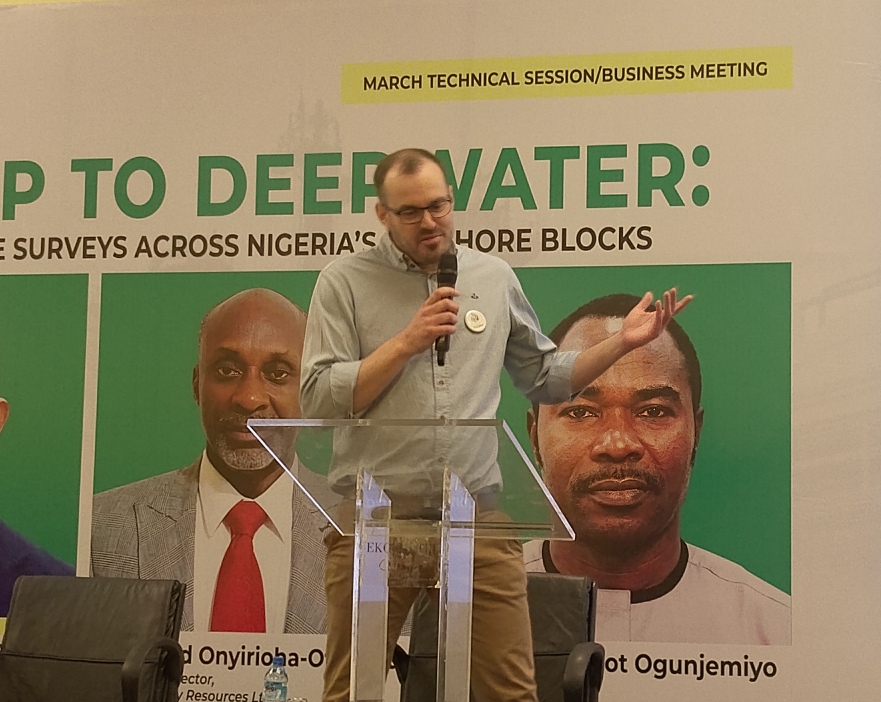
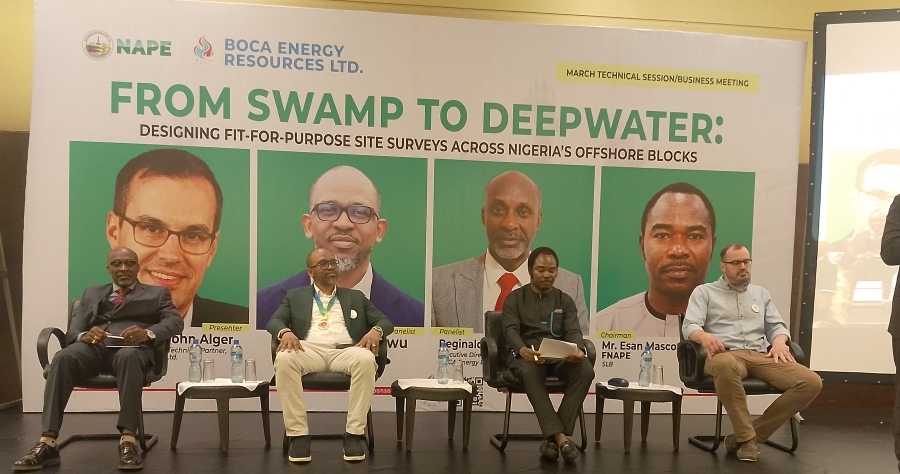
A leading geophysical expert and Technical partner of BOCA Energy, Mr. Christopher John Alter, has sounded a stark warning to operators chasing lower project costs: the real financial danger in offshore drilling lies not in spending too much, but in spending too little where it matters most. Principal Geophysicist and Tech Partner, revealed that inadequate site surveys continue to trigger some of the most expensive failures in the global oil and gas industry.
Speaking during a technical session at the Nigerian Association of Petroleum Explorations (NAPE), March Technical/Business Meeting 2026 sponsored by BOCA Energy, held at Ballroom, Eko Hotel and Suites, Alter dismantled the growing tendency among operators to treat survey budgets as expendable. He stressed that while companies aim to optimize costs, neglecting critical pre-drilling investigations often leads to catastrophic financial and operational consequences.

According to him, the global energy landscape is witnessing a subtle but significant shift. As renewable energy projects, particularly wind farm developments, experience a slowdown, traditional oil and gas operations are quietly regaining momentum. Alter explained that the industry naturally moves in cycles, with reduced activity in renewables redirecting expertise and investment back into hydrocarbon exploration.
However, he warned that this renewed focus comes with familiar risks, especially when companies repeat past mistakes. At the center of these errors is poor survey planning. Alter emphasized that site surveys are not optional technical exercises but the backbone of offshore safety and efficiency. Referencing global safety standards set by the, he noted that every offshore operation must prioritize the protection of personnel, assets, and the environment.
He broke down the technical significance of surveys, explaining that they determine critical parameters such as water depth, seabed composition, subsurface geology, and the presence of existing infrastructure. These variables directly influence drilling strategy, rig selection, and pipeline routing. Ignoring or underestimating them, he warned, can result in severe incidents, from pipeline rupture to full-scale drilling failure.
Drawing from industry experience, Alter highlighted cases where undetected shallow gas, hidden faults, or seabed obstructions caused equipment damage and operational shutdowns. He cautioned that the fundamental objective of any survey is to reduce uncertainty, stressing that any survey that fails to mitigate risk effectively represents wasted capital.
Turning attention to Nigeria, he described the country’s offshore terrain as both promising and highly complex. From swampy coastal zones to ultra-deepwater fields, each environment presents distinct geological and operational challenges. According to him, assuming uniform conditions across locations is a costly misconception that has repeatedly undermined projects.
He noted that operators in Nigeria must contend with unstable seabed conditions, shallow gas interference, logistical bottlenecks, and limited access to specialized geotechnical vessels. These constraints, he said, make it imperative to adopt tailored survey strategies rather than generic, one-size-fits-all solutions.
Alter further explained that different environments come with unique technical risks. Swamp and nearshore zones are plagued by soft soils and accessibility issues, while shallow waters complicate seismic data acquisition due to gas interference. In deepwater settings, the stakes rise significantly, with hazards such as slope instability, complex seabed structures, and gas hydrates posing serious threats to drilling integrity.
He stressed that effective survey planning must begin with rigorous risk assessment, not budget trimming. Engineers, he said, should first identify potential hazards, build a comprehensive risk register, and then design data acquisition programs accordingly. In some scenarios, he added, existing 3D seismic data may already provide sufficient insight, eliminating the need for redundant surveys.
Addressing marginal fields, Alter warned operators against applying conventional survey templates to high-uncertainty environments. Such fields, often lacking historical data, demand broader and more detailed investigations to manage elevated geological risks.
To mitigate these challenges, he advocated for deeper integration between geophysical and geotechnical data, early-stage collaboration between operators and contractors, and smarter, data-driven planning frameworks. He maintained that precision, not minimalism, should define survey execution.
Alter concluded with a blunt industry reality: the cheapest survey is often the most expensive mistake. As oil and gas regain strategic relevance, he warned that any attempt to cut corners at the exploration stage could trigger long-term financial losses and operational setbacks that far outweigh initial savings.