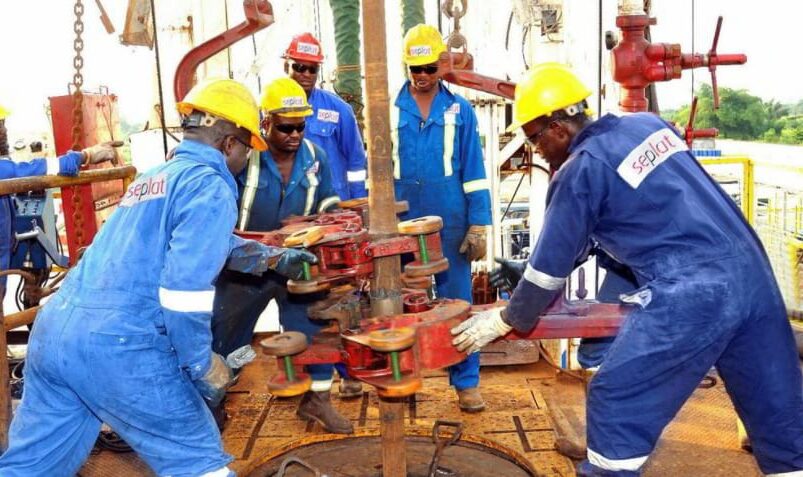
Seplat Energy Plc, the Nigerian oil and gas company that acquired ExxonMobil’s onshore and shallow-water assets in a landmark $1.28 billion deal, has successfully restored 49 idle wells to production as part of an aggressive turnaround strategy, and is already planning to bring 50 more back online this year.
The Lagos- and London-listed producer disclosed the achievement in its latest audited financial statement, describing the idle well restoration programme as “the cornerstone of growth delivered offshore in 2025.” The campaign delivered an additional 48,600 barrels of oil per day in gross production capacity at a gross cost of approximately $60 million, underscoring the capital efficiency of the programme relative to greenfield drilling.
“We successfully restored 49 idle wells as part of the 2025 idle well restoration programme. The 2025 programme was strongly value-adding, delivering an additional 48.6 kbopd gross production capacity during the year,” the company stated.
50 More Wells in the Pipeline
Building on this success, Seplat has set a target of restoring an additional 50 wells through 2026, extending the programme into a second phase even as it acknowledges diminishing returns. “Our base assumption is that production additions per well will decline as the idle well portfolio matures,” the company noted, signalling to investors that while the economics remain compelling, the low-hanging fruit is gradually being picked.
The idle well strategy sits at the heart of what Roger Brown, Seplat’s Chief Executive, has cast as a broader transformation of assets that were, in his words, “historically under-financed” under ExxonMobil’s stewardship. Brown has described Seplat’s offshore investments as witnessing “renewed vigour,” resulting in unlocked capacity and enhanced reliability—a pivot that has yielded immediate results in terms of elevated production capacity.
Offshore Performance Surges
The wells programme helped propel offshore output to new highs in 2025. According to the annual report, Seplat’s offshore assets delivered average daily working interest production of 76,023 barrels of oil equivalent per day, representing year-on-year growth of approximately 9 percent on a pro-forma basis. Management noted the strong performance was “aided by the idle well recovery programme and improved asset performance,” partially offset by planned maintenance activities and an outage at the Yoho platform following a fire in the third quarter.
The Yoho platform, which has remained out of service since the fire, is expected to return to production in the second quarter of 2026, with the production uplift from restoring Yoho estimated at approximately 20,000 barrels per day. That recovery, combined with the second phase of the idle well programme, is expected to provide material volume support as Seplat navigates a year of significant capital deployment.
Financial Transformation Underway
The idle well revival sits inside a much larger story of financial transformation. Revenue rose 144 percent year-over-year to $2.7 billion in 2025, despite a 12 percent year-over-year decline in oil prices, while adjusted EBITDA reached $1.27 billion, representing a 47 percent margin. Operating cash flow came in at $1.17 billion and net debt fell to $673 million, ending the year at 0.5 times net debt-to-EBITDA.
Group production rose 148 percent to 131,506 barrels of oil equivalent per day, reflecting the first full year of consolidated operations following the MPNU acquisition.
| Key Performance Indicator | 2025 Result |
| Revenue | $2.7 billion (↑144% y/y) |
| Adjusted EBITDA | $1.27 billion (47% margin) |
| Operating Cash Flow | $1.17 billion |
| Net Debt | $673 million (0.5x net debt/EBITDA) |
| Group Production | 131,506 boepd (↑148% y/y) |
| Offshore Production | 76,023 boepd (↑9% pro-forma) |
| Idle Wells Restored | 49 (48,600 bopd capacity added) |
Eyes on 2030: $3 Billion Capex, 200,000 boepd Target
Looking beyond the well programme, Seplat has outlined a broader production ambition. The company expects to grow its working-interest production from about 134,000 boepd in mid-2025 to over 200,000 boepd by 2030, underpinned by a five-year capital expenditure plan of up to $3 billion. This includes plans to drill between 120 and 150 new wells and validate up to three new gas projects.
In 2026 specifically, the company says production growth will be driven by higher-value natural gas liquids and gas as the ANOH Gas Plant ramps toward full capacity and an expansion at its Oso facility doubles offshore gas sales capacity.
Shareholder Returns: $1 Billion Commitment
The annual report also confirms that 2026 marks the start of a five-year period in which Seplat targets aggregate shareholder distributions of $1 billion, paid at 40 percent to 50 percent of free cash flow, with a committed minimum of $120 million, or $0.20 per share, in any given year.
Production guidance for 2026 stands at 135,000 to 155,000 boepd, representing a roughly 10 percent uplift at the midpoint over 2025.
Strategic Implications
Seplat’s successful idle well restoration programme demonstrates the value inherent in mature assets when managed with operational focus and capital discipline. By reactivating existing wells at a fraction of the cost of new drilling, the company has unlocked significant production capacity while generating strong returns for shareholders.
As the company integrates the ExxonMobil assets and executes its growth strategy, Nigeria’s energy sector gains a stronger indigenous player capable of maximizing the value of the country’s hydrocarbon resources. With the ANOH gas project coming online and further well interventions planned, Seplat appears well-positioned to deliver on its ambitious 2030 targets.